Noise from CTT SensorStation v3.2

Hi all,

Since July last year, we have deployed five stations operating at 150.1 MHz. Each station uses the same setup: four Sirio Yagi antennas connected via low-loss coaxial cables to a CTT SensorStation v3.2. The SensorStation is powered by a battery and solar panel.

Across all five stations, we have been experiencing a relatively short detection range of only 100-250 m.

While investigating this issue with a handheld VHF receiver and antenna, we detected a significant amount of noise coming from our setup, which may explain the limited detection range.

Initially, we suspected the solar panel or charge controller as the source of this interference. However, even after disconnecting those components, the noise remained. We then simplified the system further by connecting the battery directly to the SensorStation. In this configuration, the noise only appears when the SensorStation itself is powered on.

Has anyone experienced similar interference from a SensorStation, or is this level of noise considered normal? Any suggestions on possible causes or solutions would be greatly appreciated.

Thank you!

Hi Jitse,

Though I’ve not noticed this before, CTT has and recently made available filters to put on the power input suggesting it could help with VHF noise associated with RF noise on the power feed lines. I’d reach out to them and get your free filters as a first step. With any luck it will greatly help with the noise issues you’re experiencing.

Adam

Is there any other equipment nearby , radio towers , solar panels or machinery within a mile radius of each station?

If not and the noise is internal to the station, It could be coming from the dongles that are on the VHF side, Have you tried removing the dongles from the usb ports one at a time to see if the noise goes away?

Noise on a PCB can be caused from many things, failing capacitors, on the ctt there may be a bluetooth radio that can emit noise, A cellular or gps radio or even the raspberry pi can emit rf but none of these should be enough noise to cause this problem.

Trouble shooting your antennas coax and connectors could also help, poor connections and corrosion can also let in unwanted noise and loss of detection.

Loose coaxial connectors are a primary cause of noise, interference, and signal degradation in antenna systems, including Yagis. Loose connectors, especially when finger-tight or lower, compromise the shielding of the coaxial cable, allowing it to pick up electromagnetic interference (EMI/RFI) from the environment, acting as an antenna itself.

Since you mentioned it was on all 5 stations with the same setup and they are all experiencing no detection. That’s where I would suggest looking first!

A nano VNA, Antenna Anylizer device can help.

https://www.amazon.com/PM-120W-Digital-125-525Mhz-Frequency-Counter/dp/B081ZJTJ11?th=1

https://www.amazon.com/s?k=nano+vna

https://www.amazon.com/s?k=antenna+anylizer&crid=2YNBZQOZ383GS&sprefix=antenna+anylizer%2Caps%2C182&ref=nb_sb_noss_2

Rick

Some things to check:

  • Are you using FuncubePro dongles or some other SDR?
  • Have they been programmed to your 150.1 Mhz frequency?
  • Have you tried with a test tag of at that frequency?
  • Are your coax cable unusually long eg > 100ft?
  • Have you looked directly at the sensorgnome page of your sensorstation?
  • Perhaps your VHF equipment is not giving you an accurate test result.
  • Using the sensorstation/sensorgnome to measure the noise it is seeing and would eliminate the handheld VHF receiver as a variable.
  • there are two main types of noise to look at - background anthropogenic noise and random spurious ‘hits’ or ‘beeps’
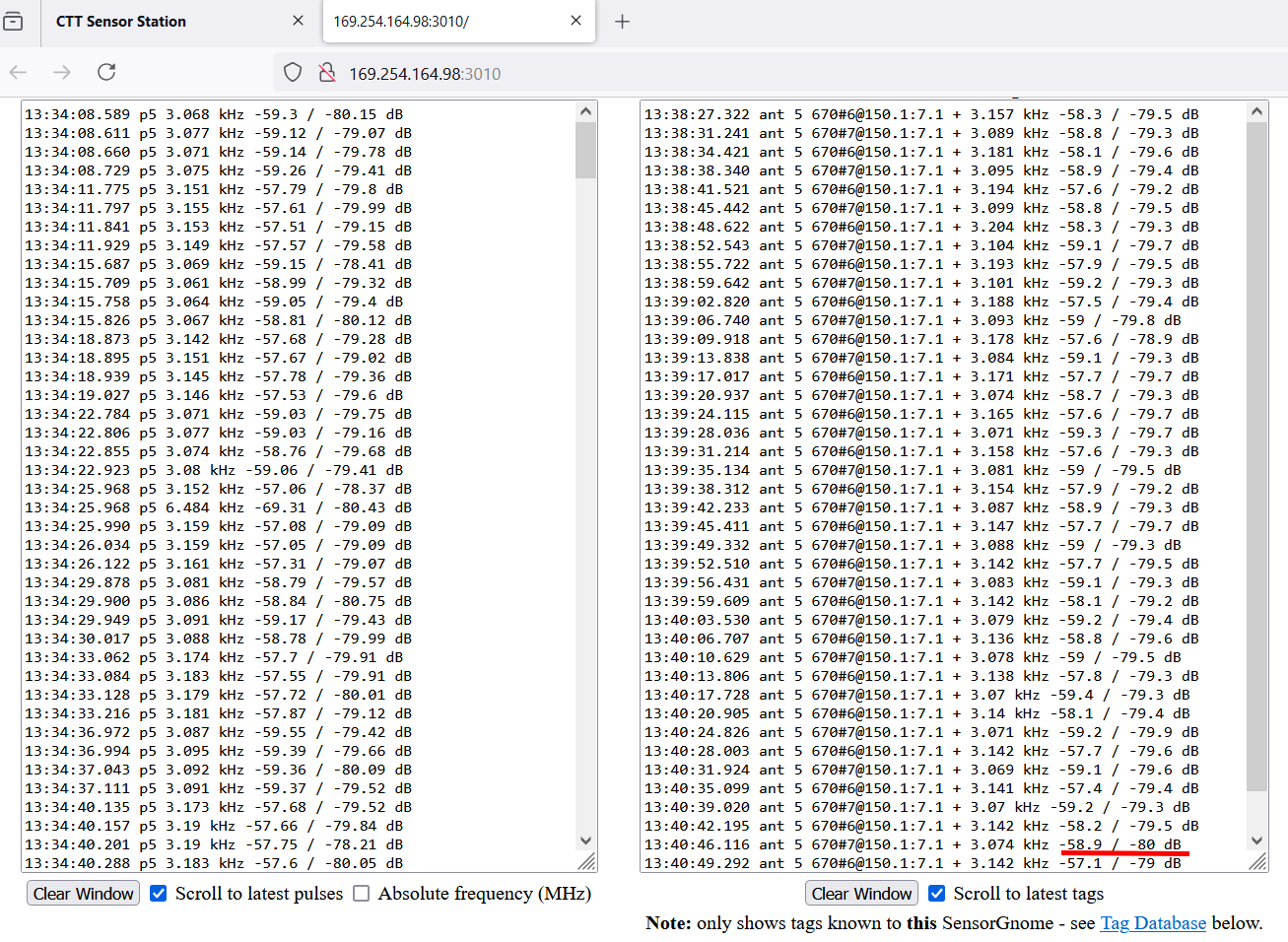
  • looking at the sensorgnome web page of the SensorStation: any hits registered will show both a signal and a noise measurement. Ideally the noise floor measurement should be less than ~ -50 or -60 dBm, (less than -80dBm is ideal). The signal from a test tag should be very strong if you are close by > -40dBM. beeps must be at least 6dBM above the noise floor to be recognized, so if your noise floor is -50dBm, tagged bird flying by must have a received signal strength of better than -44dBm. And the tag signal strength will drop the further the tag is from the receiver until it disappears in to the noise at distance.
  • If you are getting the second type of noise - that is a lot of random hits in between hits from tags, that can interfere with the tag detection algorithm that Motus depends on. By ‘lots’ I mean one hundred or more - in a minute. This would be something generating beeps at or near the same frequency as your tags. On the sensorgnome interface it looks like random, sometimes constant bursts of beeps scrolling by in the window. If there are too many - the detection algorithm cant identify a tag’s burst of 4 pulses out of all extra non-tag hits.
  • My use of test tags, once you move away from your receiver, the results seem very dependent on getting the tag up above the ground as high as your can. Even on a pole at 10ft can sometimes give very disappointing results. Sometimes there are range gaps, a tag not detected at a kilometer or two at the same elevation of the receiver in line-of-sight across a lake, can give very good results up on a hill 12Km away.

We have also had a problem of low detection range on one of our receivers, even though everything has been checked with a nano VNA and looks good. So we’re still trying to figure it out. Are you sure the issue is actually noise? Will be interested to know how you get on.

How many vhf Yagi’s do you have on the tower and what are the spacing distance vertically and the azimuth of each antenna in the order they are placed top to bottom?

The the direction and spacing are important , if the antenna’s are too close together, an antenna nearby , above , below or back to back with the others antenna will create an electromagnetic coupling with the other nearby antennas, resulting in distorted radiation patterns and reduced reception and gain and even cause increased impedence (SWR)

The result from being too close is nulls and dead spots , reduced overall reception, noise or interference and even reciever front end overload and damage to the reciever or dongles in this case.

The antennas should be 1 wavelength apart : One full wavelength for 151 MHz is approximately 1.99 meters (or 6.52 feet)

Also spacing the antenna at 90 to 120 degrees apart in opposite directions of the next antenna on the boom.

For an example North at 0 degrees East at 90 degrees South at 180 degrees West at 270 degrees

Some stations have used only 3 VHF antennas to get the spacing and set their antennas at 120 apart .

N = 0 E=120 W=240

Rick

Hi Adam,

By deploying these CTT Power Filters, the noise is reduced a lot already. At short ranges, I can set the system to low gains with hardly any noise. However, when I increase the gain the noise becomes too high. If I test the tags, I can only detect them from a maximum of 100 meters. Further than that, the signal disappears below the noise floor.

Jitse

Hi Rick

Thanks for the advice!

If I test the surrounding with a handheld Yagi, the noise does not seem to be abnormally high. With the directional Yagi at a low gain, it seems to be the case that the noise comes from the station itself.

I checked how the noise changes when I remove the dongles, and while it indeed removes some of the noise, it does not seem to fix the very large amount of noise that is still present.

I also tried to remove the coax connections to the station to see how that changes noise. However, the noise did not change a lot with removing those. Either that is because the noise is not coming from there, or the connectors are indeed causing the noise and it doesn’t matter whether I they’re connected or not.. I’ll have to double check with an antenna analyzer.

We have low-loss coaxial cables, with soldered N-type connectors. Do you know if there are better ways to attach connectors, e.g., are solderless connectors better or more consistent?

Thanks!

Jitse

  • We were using Nooelec Smart dongles. However, by doing some additional tests I noticed that the Funcubes were producing slightly less noise, so I switched to that.

  • They are programmed correctly by type and frequency in the deployment file.

  • We tried with two different types of tags, they are detected when close to the station. But after 100-ish meters, the signal disappears below the noise floor.

  • All of our coax cables are less than 10 meters (+/- 32ft)

  • During some additional tests, I checked the Sensorgnome page directly.

The tag was placed at a 60 meters from the station, in the direction of antenna 3. I have the feeling based on these values, that the noise is a little high (since you mentioned that less than -80 is ideal) and the tag signal is already -40 at close range? I’m not very skilled at reading (and interpreting) this Sensorgnome page though. Is there anything that stands out?

Hi!

We’re not really sure of anything yet. We’re trying to do as many tests that we can to ensure we’ve covered all possible issues. We will keep you posted on what we find!

Hi Jitse

That is an unusual noise situation, hopefully the antenna analyzer will reveal more.

As far as connector we use the Amphenol Crimp connectors. They are a more expensive but have been reliable and easier to install , Shrink tubing , vapor seal and butyl tape have also helped keep out moisture and corrosion, that we found on other installations causing noise .

Were you able to narrow the noise down to a frequency range without the antennas or dongles connected,

If the noise is coming from the board itself , It’s most likely due to failed capaicitors or filters or lack of filtering on older boards.

The newer boards use 5 Lora receive radio’s on the uhf side (on older boards FSK ) that can produce noise , although very low level , Other radio’s like bluetooth and cellular are are also on board and have antennas that can absorb noise back to the board.

Without seeing the noise spectrum on the board and the the decibel levels it makes it makes it hard for me to troubleshoot it.

what I have found is that most of the noise I’ve seen is coming from a source outside the Motus station , Nearby electrical interference , or distant noise getting in the antenna and coax, even cell towers and satellite transmissions. I am not sure of your location and potential noise environment,your area may even need higher shielding on the coax ( LMR 600?)

List of Satellite Frequencies by Band### VHF Band- 136 – 138 MHz: This band was used heavily by many different types of satellites in the past. Today (2023), most activity is restricted to 137-138 MHz (which is the current allocation) and consists of meteorological satellites transmitting data and low-resolution images, together with low data rate mobile satellite downlinks (eg Orbcomm)

  • 144 – 146 MHz: One of the most popular bands for amateur satellite activity. Most of the links are found in the upper half of the band (145 – 146 MHz).
  • 148 – 150 MHz: This tends to be used for uplinks of the satellites that downlink in the 137 – 138 MHz band.
  • 149.95 – 150.05 MHz: This is used by satellites providing positioning, time and frequency services, by ionospheric research and other satellites. Before the advent of GPS it was home to large constellations of US and Russian satellites that provided positioning information (mainly to marine vessels) by use of the Doppler effect). Many satellites transmitting on this band also transmit a signal on 400 MHz.
  • 240 – 270 MHz: Military satellites, communications. This band lies in the wider frequency allocation (225 – 380 MHz) assigned for military aviation.

UHF Band- 399.9 – 403 MHz: This band includes navigation, positioning, time and frequency standard, mobile communication, and meteorological satellites. Around 400 MHz is a companion band for satellites transmitting on 150 MHz.

  • 432 – 438 MHz: This range includes a popular amateur satellite band as well as a few Earth resources satellites.
  • 460 – 470 MHz: Meteorological and environmental satellites, including uplink frequencies for remote environmental data sensors.

There are also newer technologies out there that introduce a different range of noise issues , especially in Europe where the LoRa technology has explodes in popularity with government ,Industry and amateur radio .Even though it’s primary use is in the 800 mhz band it’s also in use in the 400 mhz and has military use in the vhf bands.

In short, If the noise source can be narrowed down to a specific frequency range and decible noise level , tuning to and away from that level can help determine the cause,

metal shielding around the sensor station could also help determine if the noise is being injected direct onto the board or coming from the antenna and coax.

Your is a very interesting and challenging situation.

Where is your station geographically located? You have my curiosity peaked !

Good Luck in your quest!

Rick
Hi Jitse

Switching to the Funcube dongles will help and make sure the foil tape is wrapped around the dongles for rf shielding protection and some heat dissipation from the dongles, since they can heat up and fail.

Coax lengths look good tag signals look good ..below -70 dbi is good

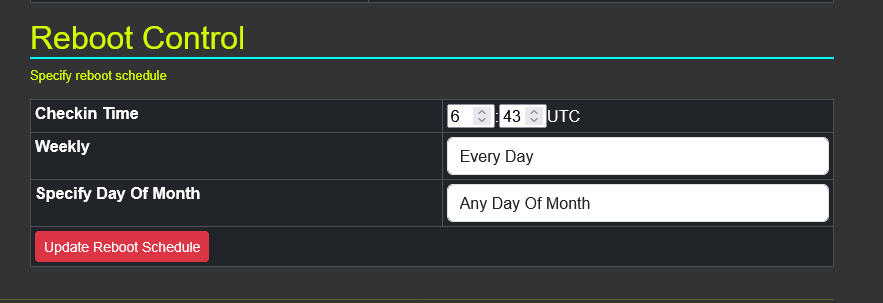
Just out of curiosity have you changed your reboot schedule to have more frequent reboots to keep the buffers clear and prevent lockups? just wanting to make sure there are no other underlying problems?

All of our stations are in Belgium. The noise problem is consistent on all of our stations, but the one I’m currently doing the tests on is here: Google Maps .

I performed a test where I directly connected a handheld VHF receiver to the SMA port, and when I left the SensorStation on, I could only detect tags up to 100 meters (before they disappeared below the noise floor). If I repeated the same test with the SensorStation off, the tag was still detectable after 500 meters (after which I stopped going further away). This leads me to believe the problem is not with the antennas or coax cables.

I tested another unit of SensorStation at my house, directly plugged in. The noise stays the same, so I think that also excludes the solar panel or charge controller.

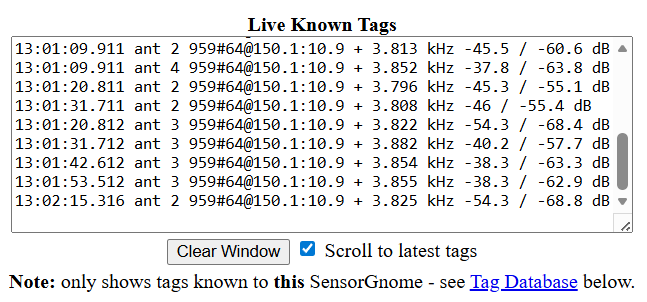
In your list, it seems that the 150MHz frequency band is also occupied by the GPS? So is it possible the GPS module is interfering? Strangely, I never seem to get any GPS fixes, if I look in the Sensorgnome interface:

image

The reboot is set as in your screenshot. I never changed any parameters there, so it is still the same as it was when I installed them.

Kind regards

Hi Jitse

Nice catch on the GPS not working, I ve never seen a GPS in the 155 MHZ range but it could be in the 1500 mhz range?

Are you using an external gps antenna with an sma connector or the onboard gps? if the station is in a metal building on enclosure , an external gps antenna is needed.

Rick

We use the onboard gps. However, the enclosure we use is not metal and should be able to work despite no external antenna. Does the GPS module work on the separate 3V battery? I can try replacing that to see if that solves the problem?

Is it possible the GPS is causing the noise? It seems weird that if it’s not working, that it would create any interfering signal?

Hi Jitse and others,

For all who are thinking it are the cables… this video says more than 1000 words…

The tests we did by the stations pointed down to the board of the SensorStation V3.2. I am expecting there is something wrong in them. Hopefully CTT is coming soon with a solution; that saves you a lot of hassle. Sending them in for repair before the Nightjars are coming back would be helpful for your PhD thesis.

Interesting to hear that one user has also troubles with the dection range. With so much noise, for sure the detection range is horrible. Is that SensorStation also a V3.2 version? Maybe from the same batch?

All the best and succes to find the solution to get rid of the noise, Jitse!

It’s interesting that there are multiple users having the same problem, Has anyone contacted CTT about the issue?

I’ve experienced similar issues on LoRa ESP32 devices in the 915 and 433 mhz where I had to install Saw filters to reduce noise and to notch to those frequencies.

I haven’t looked at the the wiring diagrams for the CTT V3 boards yet, But I suspect they most likely have these filters installed . If they are installed and have failed or were defective at the time of installation, This type of noise problem could happen? A call to CTT might help?

Rick

I’ve contacted CTT. They have let me know that the noise is likely RF interference from the SensorStation’s own electronics (compute module, USB hub, onboard voltage regulators). The PowerFilter apparently should address the noise through the power cables already, but additional RF noise can be picked up by dongles and nearby coax cables. Apparently this is a known limitation of the V3.2 hardware?

They proposed a couple of remedies, though I’m sceptical whether they would properly address and solve the problem. A physical separation between station and antennas could help. Though the receiver is already 5-ish meters from the antennas, and if I move the SensorStation away from the mast, I will always have one antenna that picks up the noise?

Snap-on ferrite chokes could help, on USB connections between dongles and sensorstation, coax cables, power input cable. Or shielding the enclosure, since we’re using the NEMA weatherproof enclosure. Though, here I am worried that it would also block modem connection or GPS. Maybe the higher wavelengths will make sure that the foil does not interfere too much, I don’t know.

Finally, in the longer-term a V3.3 upgrade, which includes improved EMI filtering, better heat dissipation, and a redesigned USB bus. Though this of course does not help us with our current V3.2 stations.

Hi folks,

I’d like to chime in that I was able to get down to -80 dB noise levels using a V3.2 SensorStation:

This gave us a detection range of ~1100m with both the tag and antenna at a height of ~4m. Better tag + antenna height will improve this figure.

I’ve had to deal with a lot of SS noise myself, but for me, the source was always related to the power supply. Having a linear power supply instead of a switched one greatly reduced the noise for our setup. Similarly, when connecting a car battery directly to the SS, I also got noise, because my connections were bad. I’d recommend testing different power supply options and seeing how the signal changes - it might be another factor that introduces noise into the system, even if you wouldn’t necessarily expect it.

See also my post: Maximum detection range of Lotek nanotags - #17 by Lynn_ten_Napel about the noise issues I was having.

That’s not good news for for V3.2 station owners, It would seem to me that CTT would have detected those noise related issue’s in their testing before releasing the boards or would buy back or exchange them for the v3.2 boards? Ferrite chokes can help to some degree an external gps antenna could allow you to add a metal enclosure , but that can introduce radiated heat within the box and heating of the metal in the summer, At that point fan and more power will be needed , adding more rfi and noise potential. another thin layer of foil can also help the Rf shielding of the dongles, but again adding more heat to the enclosure .

Another option would be to use better quality sma jumper cables and connectors , I have notices that the jumpers used in the sensor stations have had bad crimps and have come loose from the sma connector, and tested bad on the Bird antenna and cable analyzer.

Better quality jumpers would help the CTT boards , There are manufactures of better grade and ultra low loss jumpers for the mircowave bands from Samtec and others that would be better choices for the CTT boards than what they use now? With CTT knowing how critical it is to keep out RFI for these low power transmitters better care would be taken to assure that the boards were capable of the the task before they were sold for deployment?

These are all band-aid fixes with no guarantee. The bottom line is that these boards need to be better than they are to address these issues !

With all of the noise issues with the V3.2, I would even be hesitant to purchase the V3.3 ?

Because we all know that the the V4 series will be even better ..That’s what keeps the wheels turning!

With the all of the proven LoRa ESP32 technology that’s long range low power and low noise and better filtering options that’s out there. Why are CTT and some of the others not made the changes yet? https://www.seeedstudio.com/blog/2023/09/21/revolutionizing-wildlife-monitoring-tinyml-iot-and-lora-technologies-with-xiao-esp32s3-sense-and-wio-e5-module/

The antennas will still work as long as the frequencies stay the same .