Swapping CTT Power tags 0.35g?

Hello MOTUS Hive!

Josh advices me to ask it here too, so:
For a small scale study, we need some CTT Power tags of 0.35 gram; by that, we ordered them, but the lead time is 10-12 weeks(!!)… That is too late for the study. So: do some of you have some CTT power tags left overs in stock? I am happy to swap some older ones to new ones if I receive my order on my desk. When yours runs out of battery, also no problem. I am able to refurbish them myself if needed.

Maybe Fiona Matews can help me with some, but that is for now not sure (as she will deploy the last ones this week(s).

Happy to hear from you!

René

Hi René,

I’d like to alert you and the Motus community to some issues we encountered with the 0.35 g PowerTags this field season in Rhode Island.

We purchased the 0.35 g CTT PowerTags for deployment on Prairie Warblers (PRAW) for a spring/summer 2023 study, and we chose the 60 sec pulse rates so that we could monitor movements using the CTT node array system for ~100 days (from pre-nesting, through nesting/incubation, and then the post-fledging period).

None of the 80 tags that we received for the initial order were the appropriate weight (≤ 0.35g), and thus we could not deploy tags on any female PRAW and only 14 male PRAW were heavy enough to support the heavier tags plus the attachment materials. CTT agreed and was nice enough to send us 25 new tags that were of the appropriate 0.35 g weight, although these tags came with a different antenna type from the original set (i.e., a thread-like whip antenna vs. a stiffer whip antenna on the original tags).

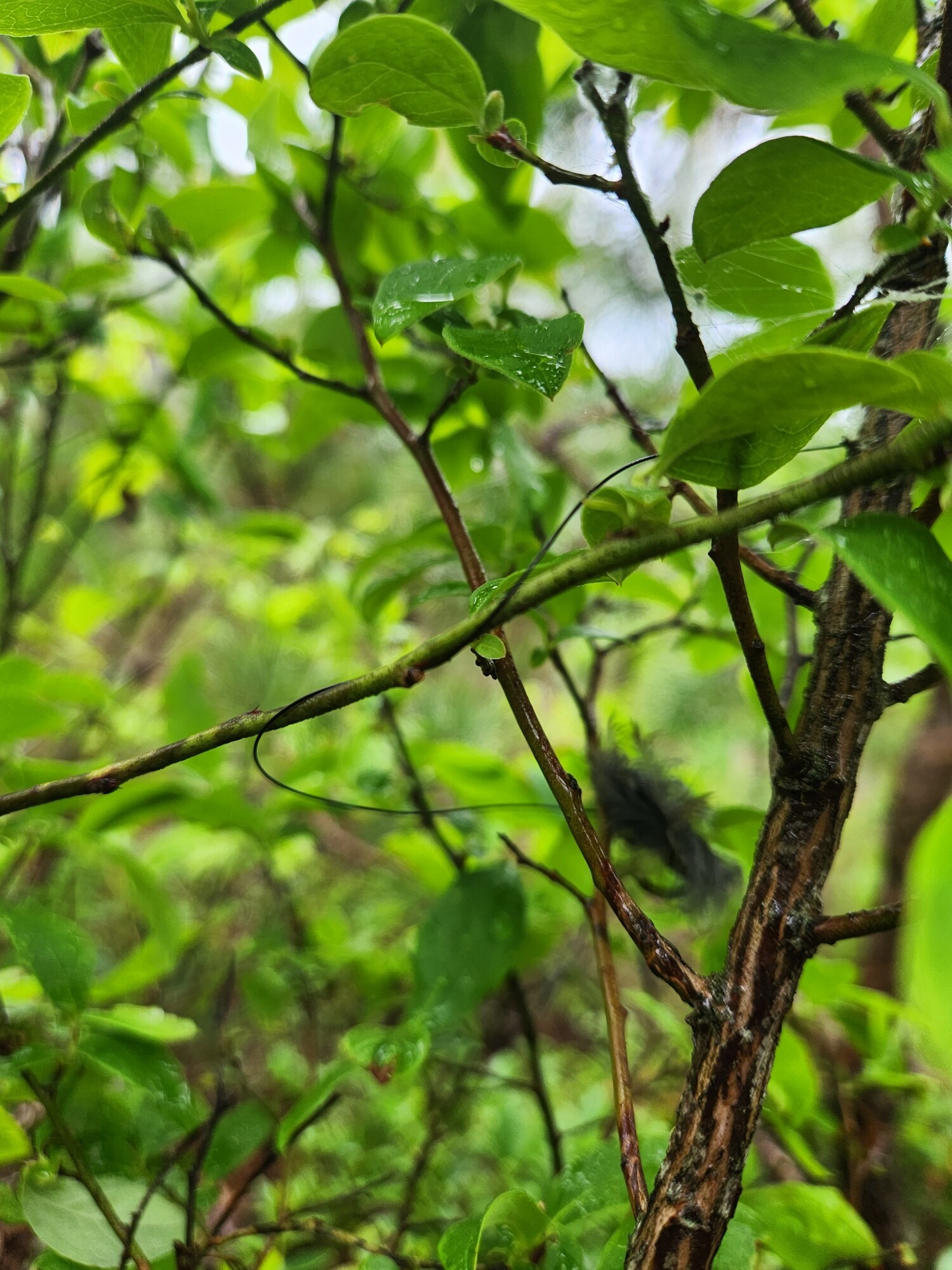
After we deployed 19 of the 25 new tags on PRAW, we noticed that within a few days of deployment most of the tags (11 of 19) were being ripped off the birds because the antenna got tangled in vegetation and knotted. The attached picture is a confirmed instance of the new antenna style getting tangled in the vegetation and being ripped off of one of our birds. This same problem has been documented in the CTT Slack Channel by Luke DeGroot.

Another issue we noticed a bit later was that the 0.35 g PowerTags w/ 60 sec pulse rate seemed to be dying prematurely (i.e., much more quickly than the advertised 100 day lifespan). We were able to verify the premature death of tags in two ways: 1) we had 12 static tags (used for calibrations of our node arrays) for which we knew the exact lifespan, and 2) we were able to resight birds that either had dead tags on them or birds that had tags fallen off, and we were able to find the dropped tags.

The confirmed lifespan on these 0.35 g tags (n = 64) was on average 29 days (range: 8-50), well less than half the lifespan reported by CTT; this meant we were unable to document much of the breeding season and any post-fledgling movements or departures from our study area as planned.

In sum, the thread-like whip antennas can be a major problem if being put on birds that are regularly in vegetation, and the longevity of the tags may not be as advertised.

I would be interested to hear from others who may have experienced similar problems. Perhaps our problems were a more isolated one?

Seems like you just antennas that were far too long for your species, regardless of weight. Those are specifications you should’ve noticed or bought to the manufacturer… I’ve seen better luck with other warblers that were just fledglings a decade ago. Blaming the manufacturer after putting those out is your own negligence. Especially when they can be cut to length at any point.

Jared Feura, M.Sc.
jfeura@gmail.com
(814)598-8854

Let’s please try to keep it civil here. We’re all on the same team :)

Issues with weights and battery life not being quite as advertised are of interest to all of us – researchers and manufacturers alike. We’re all aiming to improve the process at every stage.

And while cutting antennas is an option, it comes with its own drawbacks and has to be decided, and ideally discussed with the manufacturer, on a case by case scenario considering the tag properties as well as the species and its behaviour. There is, after all, a reason the manufacturer selected that antenna length in the first place. The topic of when, and when not, to trim antennas is a great one for another thread!

Happy motusing, everyone!

Hi Scott,

We have had similar problems with sparrows. When we first put tags on birds (>15 years), entanglement was an issue and we quickly backed off from tagging. We followed up by surveying the research community and found that many others had had similar experiences, especially with birds that live in dense vegetation (for example, grassland sparrows, like those we were studying). Overall we found that about 1/3 of species reported on in the survey had had problems (but, not a random sample of species/studies!). We also found that very few people had documented these effects in the literature - often because, like us, they abandoned the study quickly and/or sample sizes were small so hard to publish.

A few years ago, we revisited telemetry, hoping that newer materials and improved methods might result in fewer problems. In our first pilot year, we were very judicious in our approach, but had no problems at all, so we decided to move ahead with the planned bigger study. In our second year, however, we saw the same entanglement problems even though we were using the same tags. It turned out that the antenna material had changed slightly between years, and that seemed to be the cause of the problem. We were able to make a switch back, and the problems went away again.

My take-homes are (a) seemingly very subtle differences in transmitter/antenna design can change outcomes, even within species/system, (b) we should be doing much more systematic reporting of problems even though it is often hard to do so, and (c) there are likely some clear patterns among species about where to expect problems, but they're hard to document because no individual research team has the necessary data.

Following our 2007 poll, we recommended the creation of an online repository of information on telemetry problems that would be collected systematically and allow for better information transfer among researchers, and periodic reviews using the crowdsourced data to look for patterns that no individual researcher could ever find. We got little traction, and because telemetry is not a major focus for our group (perhaps a poor excuse), we didn't do it ourselves. I wonder if the Motus network could be the way to make that happen?

Results of the survey we did are here:
Hill, JM, and CS Elphick. 2011. Are grassland passerines especially susceptible to negative transmitter impacts? Wildlife Society Bulletin 35:362-367.

Information about our more recent experiences will be in a forthcoming paper.

Chris

Chris Elphick
he/him/his
Ecology & Evolutionary Biology
University of Connecticut
http://elphick.lab.uconn.edu/
http://www.tidalmarshbirds.org/
http://ctbirdatlas.org/
https://entogem.github.io/
https://statusofinsects.github.io/
Yeah since antenna length is directly associated with the frequency transmitted or received cutting it without having a serious discussion with the company making them is probably a bad idea. I know whip antennas and tiny radio equipment in general can be finicky so both researchers and manufacturers deserve some allowance for messing things up. That being said, this sounds like a problem on the manufacturer side.

You need to look at the physics and go with ¼ or ½ wavelengths. Cutting antennas at random lengths is not a good idea if you want to obtain optimum performance.

This is a good website to use.

http://www.csgnetwork.com/antennagenericfreqlencalc.html

Thanks

Nigel

On the question of entanglement of antennas in vegetation; you might find this 2011 meta-analysis by Hill and Elphick of interest:https://wildlife.onlinelibrary.wiley.com/doi/full/10.1002/wsb.84. The fundamental conclusions: they are fairly widespread, but rarely documented in the literature.

Dear all,

Whip antennas on tags are always too short in an electromagnetic sense. You will realize by comparing the length with your receiving Yagi elements that typically are 1/2 wavelength (~1 meter at ~150 MHz).

So it is a compromise, and I am sure LOTEK experimented quite a bit when they decided the length to get it as good as possible. Things get more complicated since the bird’s body will also affect the radiation characteristics. Probably also how well the tag is electrically connected to the body (glued directly on the back, taped to a tail feather, etc, etc),

So it’s a very complex problem to predict the radiation pattern and efficiency. The simplest rule of thumb I can come up with is to have the whip as long as practically possible. Cutting will probably make things worse, but sometimes you just have to or the tag will get stuck somewhere or the bird will remove the tag by grabbing the antenna (shrikes and tits are masters of this).

/Arne