We have a relatively new SensorStation running 5 antennas @ UHF (brand new) and 4 antennas @ VHF (2 brand new 5-eles and 2 older 9-eles) connected by funcubes. On manual upload until the internet in that building is back online.
https://motus.org/data/receiverDeployment?id=10514
On 5/30 we and VAPIPL (#514) deployed 6 tags at our study site ~4-6km from our station. The birds stayed in range for ~6-8 weeks before migrating south in July. We received 0 detections for any of those tags at our station. 5 of the tags were detected at towers south of the project area, so no issues with the tags themselves.
We’ve been attempting to troubleshoot issues ever since. The tower has picked up plenty of detections on the UHF antennas, but still nothing on the VHF side. Some of our parameters (framerates, etc.) were bad so the station was wiped and updated in August. It did finally pick up a test tag (the 2 EATO detections) while it was directly underneath the tower, but couldn’t detect that tag at our study site while flown on a kite at ~40-150 feet. We also flew a different test tag in September, but couldn’t get any detections even at 1000m away and 15-80ft high. That tag was also detected only directly under the tower. When driving away to the test areas, it seemed as though we lost detection at a couple hundred meters.
Site coords: 38.87687562896915, -75.2630318353592
Just wondering if there are any problems folks can see or if there are any suggestions for things to try next.
Hi Erin! Sounds frustrating! I think you need to test everything one step at a time (sounds like you already did some of that). Did you follow the issues with multiple FCDs and associated software updates? FUNcube sample rate dropping and disconnecting - FIXED
It may be worth disconnecting all but one FCD and then focusing your tests on range with that one FCD and its antenna. The recent thread Maximum detection range of Lotek nanotags is a good read. I would connect to the SensorStation’s hot-spot with my phone and then slowly walk away with a test tag while keeping an eye on the detection chart on the web interface. Until I’d get out of hot-spot range… then I’d need a helper and waving…
You can also place a test tag ~100m distance then look at the text detections and compare with some of the data in Lynn’s thread. In particular pay attention to the signal level and noise level. In my experience to get to the 4-6km you write you will need a noise floor well below -70dB, prob close to -80dB. You need to get your test tag far enough away from the antenna so your signal to noise is less than 20dB to ensure an reasonably accurate noise reading. Then you can extrapolate from there. Doubling the distance reduces the signal to noise by 6dB and you need >6dB for detection.
NB: if you disconnect 3 FCDs you don’t need to worry about the software update for the many-FCD fix until you sort out your detection range issue.
I’ve done quite a few tests over the last 6 months where I’ve tried to optimise Lotek tag detection range. After a lot of time spent troubleshooting all sorts of things, my personal experience is that my problems were almost always caused by noise. (The noise levels I quote below are always with respect to an IF_gain of 0 for the FCD+ settings)
You mention that your tags are detected when they’re underneath the antennas, after which the signal quickly fades after a few hundred metres. To me this sounds like a -55dB to -60dB noise situation (that is, the noise is really bad). In a “decent” environment I’ve gotten 300m detection range with -62.5dB noise, and in a “good” environment I’ve gotten 350m detection range with -52dB noise - the signal drop-off will depend on antenna/tag height, obstructions, et cetera.
My suggestion is as follows: place a tag at the approximate limit of where you can currently (consistently) detect it. Check the live tag detections, and analyse the noise level. If it’s in the -55dB to -60dB range - or anything above -75dB in a quiet environment, really - you’ll have to check the station. Mess about with the coax cables and see how the noise changes. The thread Thorsten linked is essentially my journey to discovering that a switched-mode power supply can mess with noise levels really badly!
If it turns out you do need to check the station, and you’re having problems improving results, pictures here will be helpful. I hope you’re able to solve your problems soon!
I’m not sure exactly what was done to the FCDs - I’m totally new to motus and Aaron Coolman has been handling a lot of the technical stuff for us. I know he re-flashed (I think that’s the term?) all of our FCDs because the framerates were reading wrong and that afterwards they all were reading the correct numbers. I’ll double check with him and see if that process could be something that still needs to be done.
Just to clarify, the “detection chart” is the live pulses window on the sensorstation.local:3010/ page, yes? Can you explain where to look for noise levels?
I’ve been borrowing a test tag until now and need to return it, so I am going to order my own to continue troubleshooting. I’ll be back here with an update as soon as the tags come and I can continue testing.
There are two windows where Lotek data (150.1MHz or 166MHz, depending on the continent you’re on) will show up. The “Live Pulses” window will display any pulses detected. Generally, a Lotek tag will have four pulses in quick succession, which are used to identify the tag. I tend to mostly use this to easily see if the station is receiving anything. The “Live Known Tags” window will display any tag that is detected through a local tag database. This is what I use to get information about whether a station is able to detect a tag.
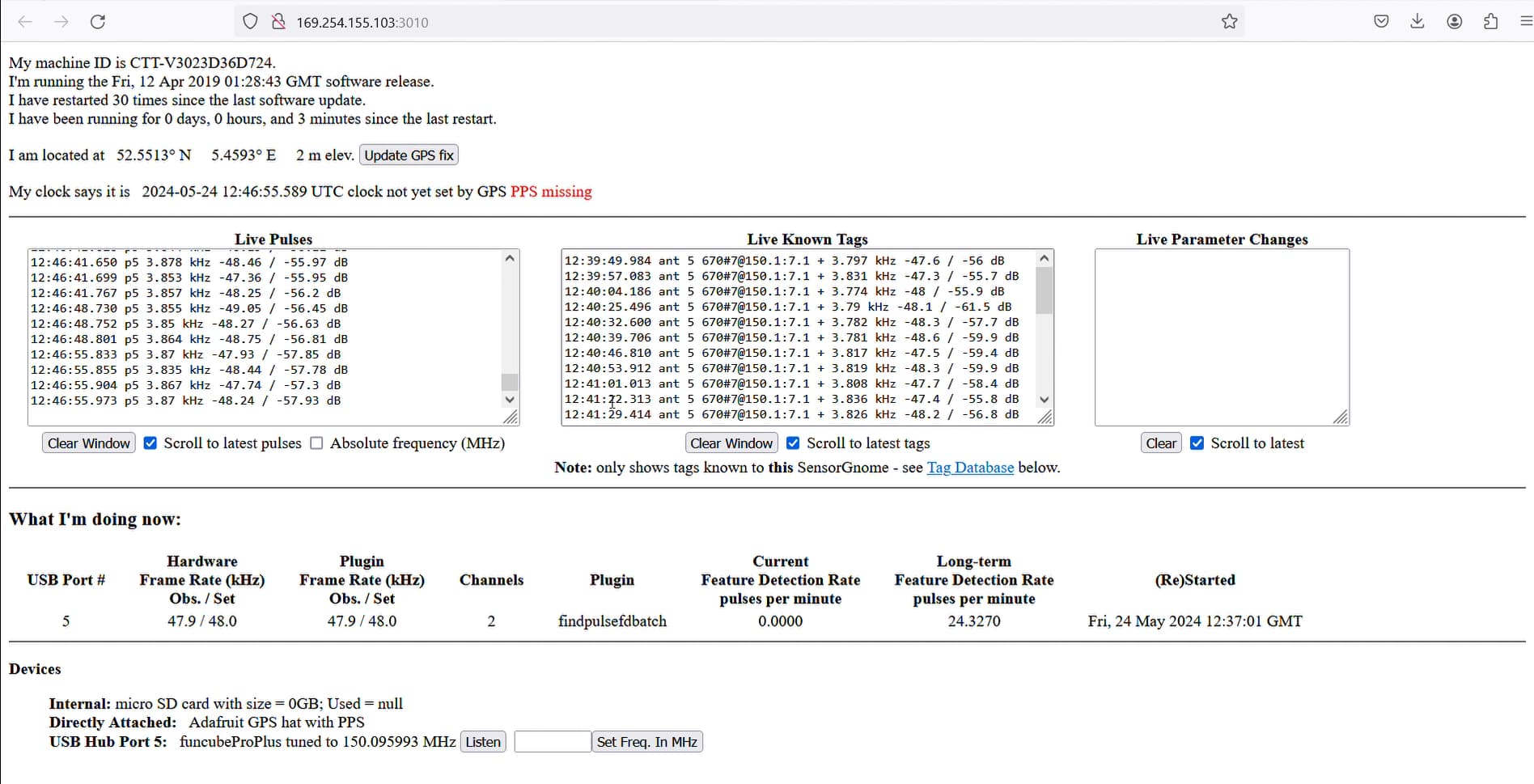
In the Live Pulses/Live Known Tags windows, you get lines that look something like this:
12:46:41:650 p5 3.878 kHz -47.36 / -55.95 for pulses
12:39:49:984 ant 5 670#7@150.1:7.1 + 3.797 kHz -47.6 / -56 for tag detections
You mostly just want the -47.6 / -56 data at the end of the line. Here the -47.6 is the signal level (in dB), and the -56 is the noise level (in dB). I personally tend to write down ~5 sample values per distance when I’m doing tests, both of signal and noise, so I always have a future reference as to how the signal behaves.
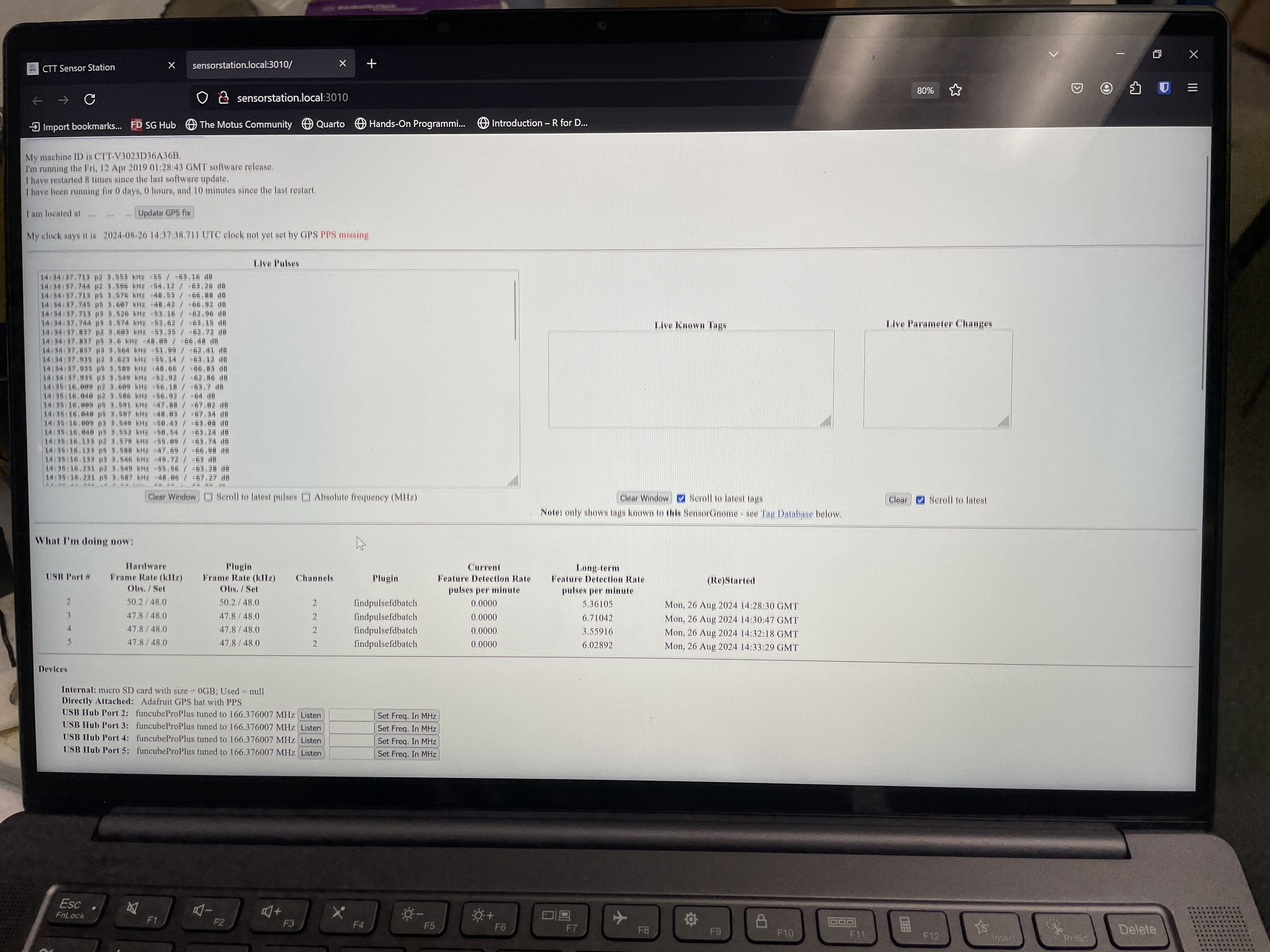
Ah okay yes I understand. Sorry for the image quality, but this is what the screen looked like after the station and FCDs were updated. It looks like the noise is in the 60s. The environment is pretty quiet as I understand it, so I’ll start with looking at fiddling with the cables when my tag comes in. When we are looking at “noise” is it ambient noise around the antennas or noise near where the actual station is? Our tower is bracketed to the side of our maintenance building and the sensorstation is mounted on the wall inside the building adjacent to where the tower is.
Looks like you have too much noise to be able to reach 1km on all three antennas for which I see pulses (2, 3, 5). P2 and P3 clearly have too much noise, P4 has 20dB SNR so the noise reading is not reliable, you need to move the tag further away or off-axis to get <15dB SNR to get a more reliable reading. (This is caused by the fact that the tag’s pulse is not perfect and radiates power in the vicinity, which is what the noise measurement reads.
Lynn had noise in the -60’s and it turned out to be the power supply. I had noise in the -60’s and it just is noise from civilization. Of your 3 antennas that detect pulses two have the same noise floor and the third seems to have a bit lower noise floor. There’s probably something that can be deduced but I’m not sure what. You also have two types of antennas…
Yes, we are running 2 9-element antennas E-W and 2 5-element antennas N-S. I’m assuming the signal from the tag is relatively static and that I am trying to get the noise levels below the signal? If that is something I can affect, anyway. The goal is 4-6km, so I’m hoping that we can make this work.
Whoops, I did already order a test tag from Lotek. Oh well!
The signal level fluctuates some due to “?”. The pulse detector recognizes a 2.5ms signal that is at least 6dB higher than the noise surrounding it in time and frequency. Every doubling of distance reduces the signal by 6dB (theoretically). So if you have 18dB SNR at 400m you can double two times (1600m) before SNR reaches the 6dB threshold. (Of course this is all just back-of-the-envelope calculation.)
I am trying to get the noise levels below the signal
Your signal is above the noise level, otherwise you would not see anything. -40dB is higher than -60dB (the negative values are confusing at first…)
To reach 4-6km your goal is to reduce the noise reading to close to -80dB. This way you get around 18dB more SNR to double distance 3 times. (Again, all roughly speaking and comparing with the low -60dB you currently have.)
When you are testing absolute range, are you using some saline solution, hot-dog or similar to which you attach the test tag without any metallic objects in the vicinity? You need something to simulate the RF effects of the animal body…
Okay that is very enlightening, thanks for laying that out for me.
I did not attach the tag to anything like you are describing, so I will attempt further tests with that requirement in mind. So far, we had just flown the tags on a toy kite to get enough height.
If using a hot dog, would wrapping it in plastic wrap or a ziploc bag affect anything? That’s going to be a weird purchase request.
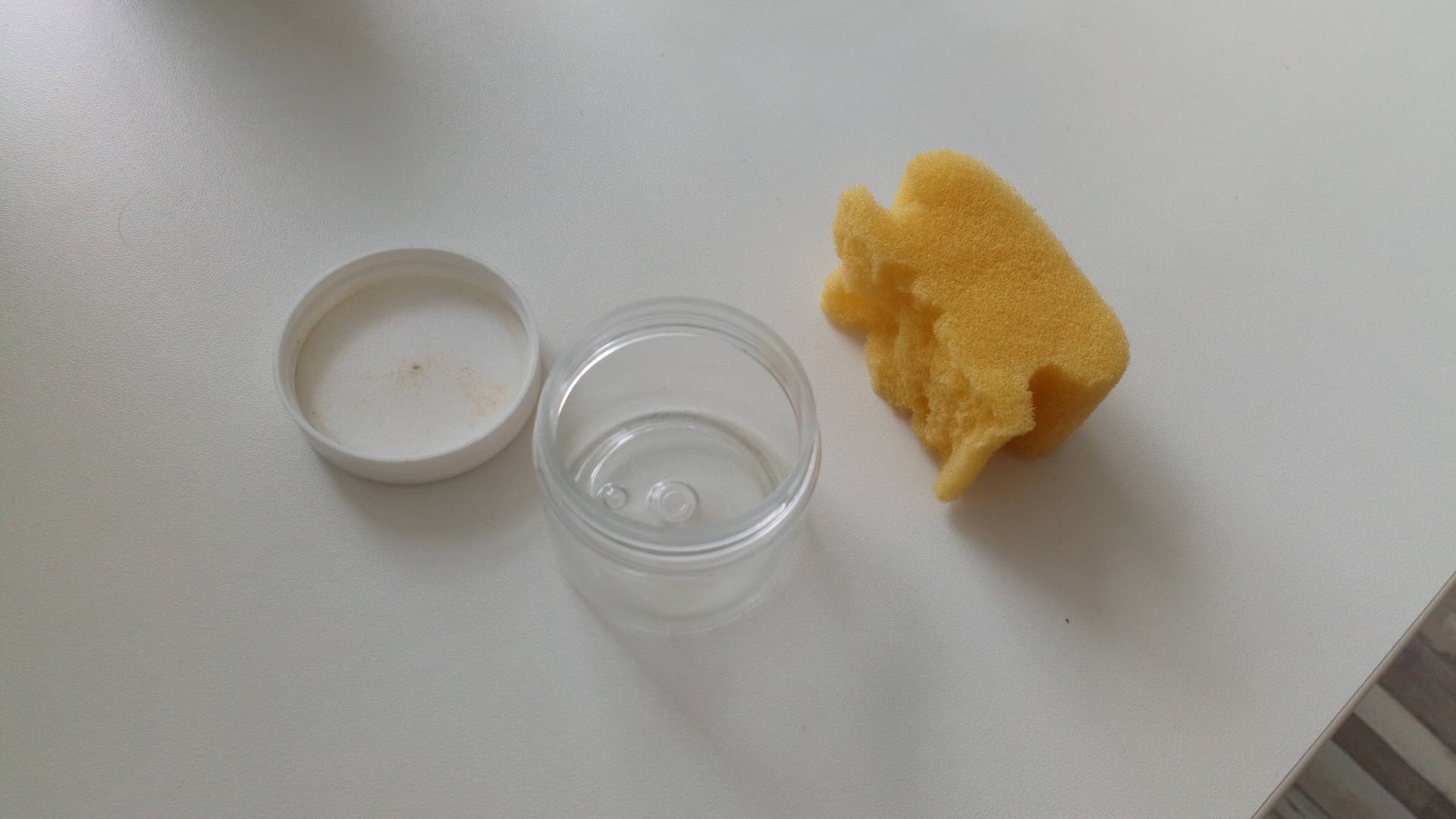
The bird acts as counter-poise to the antenna (“ground plane” if you will). This is mostly about conducting materials, most plastics don’t interfere. Saline solution conducts some, as does a hot-dog (which is some high percentage of water and minerals). I’m using a little plastic bottle into which I’ve squeezed a sponge and then added saline solution up to the approximate bird weight. I don’t really know how much the different “animal approximations” differ but I do know that they make a difference. You will also typ. see a big improvement if you hold the tag in your hand vs. up on a dry wooden stick.
If you have contacts with ornithologists, they might have a couple of dead birds laying around as well (I’ve heard they keep them in freezers…). I know that some people have attached a tagged dead songbird to a long wooden pole, and used that for testing.
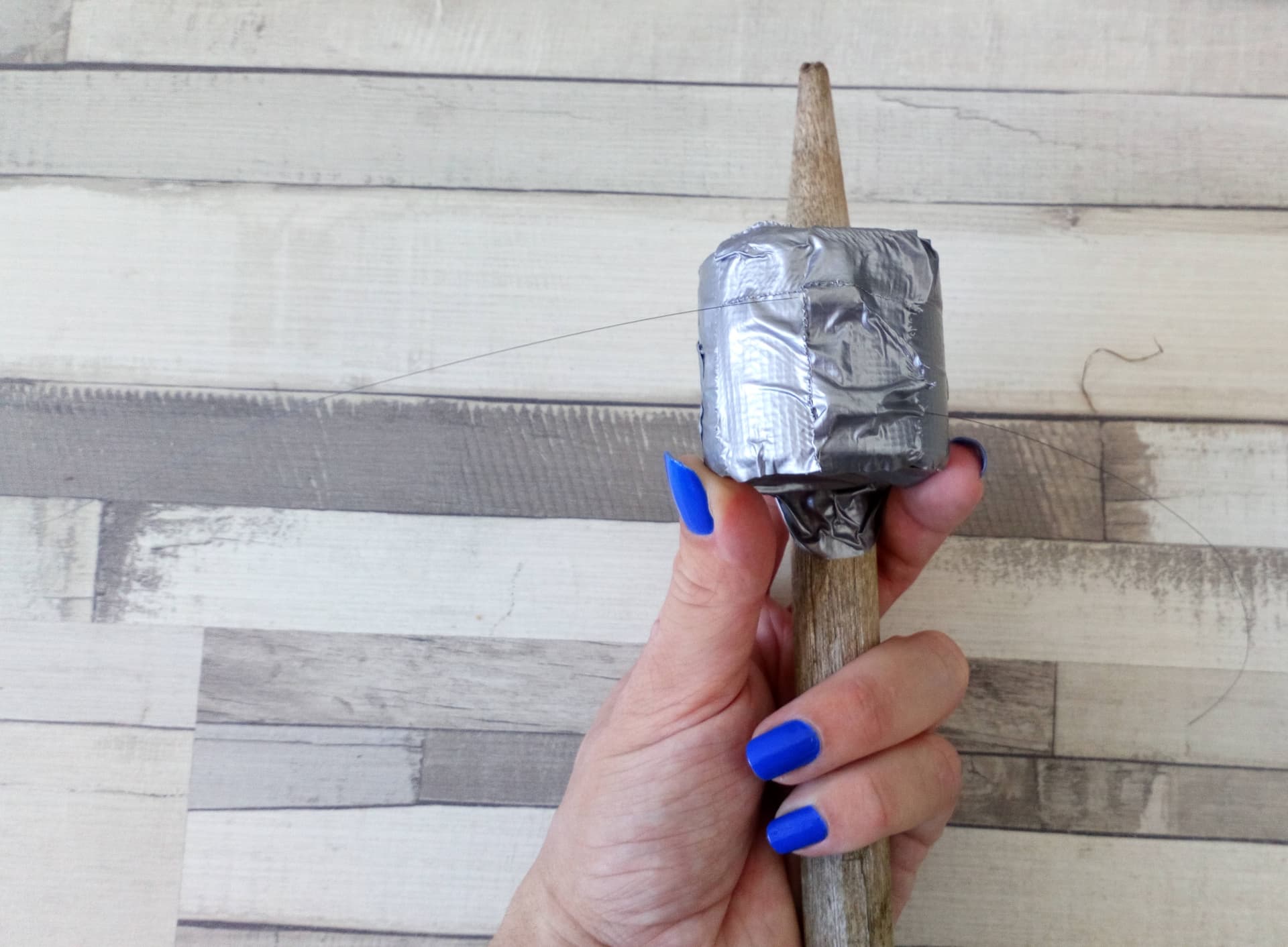
I personally used a small plastic container, into which I put a sponge and some saline water. I taped the tags to the outside of the container, so they were not in direct contact with the damp sponge.
I taped the container to the end of a wooden pole. I personally found that for testing, the signal received was strongest when I taped the tags horizontally, and then had them perpendicular to the antenna’s boom. Having the tags rotated in a different direction could easily reduce the signal strength by 5dB, if not more.