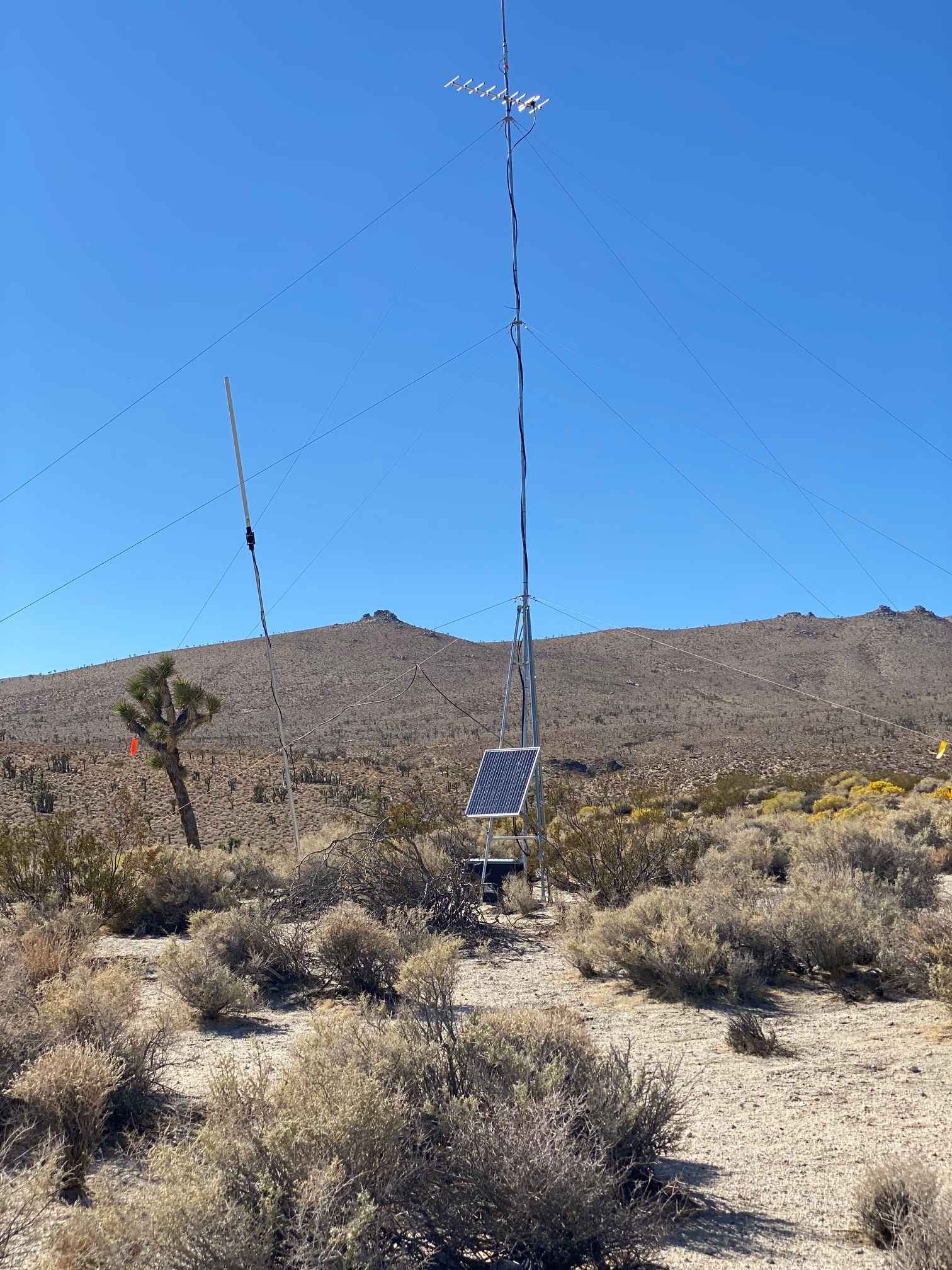
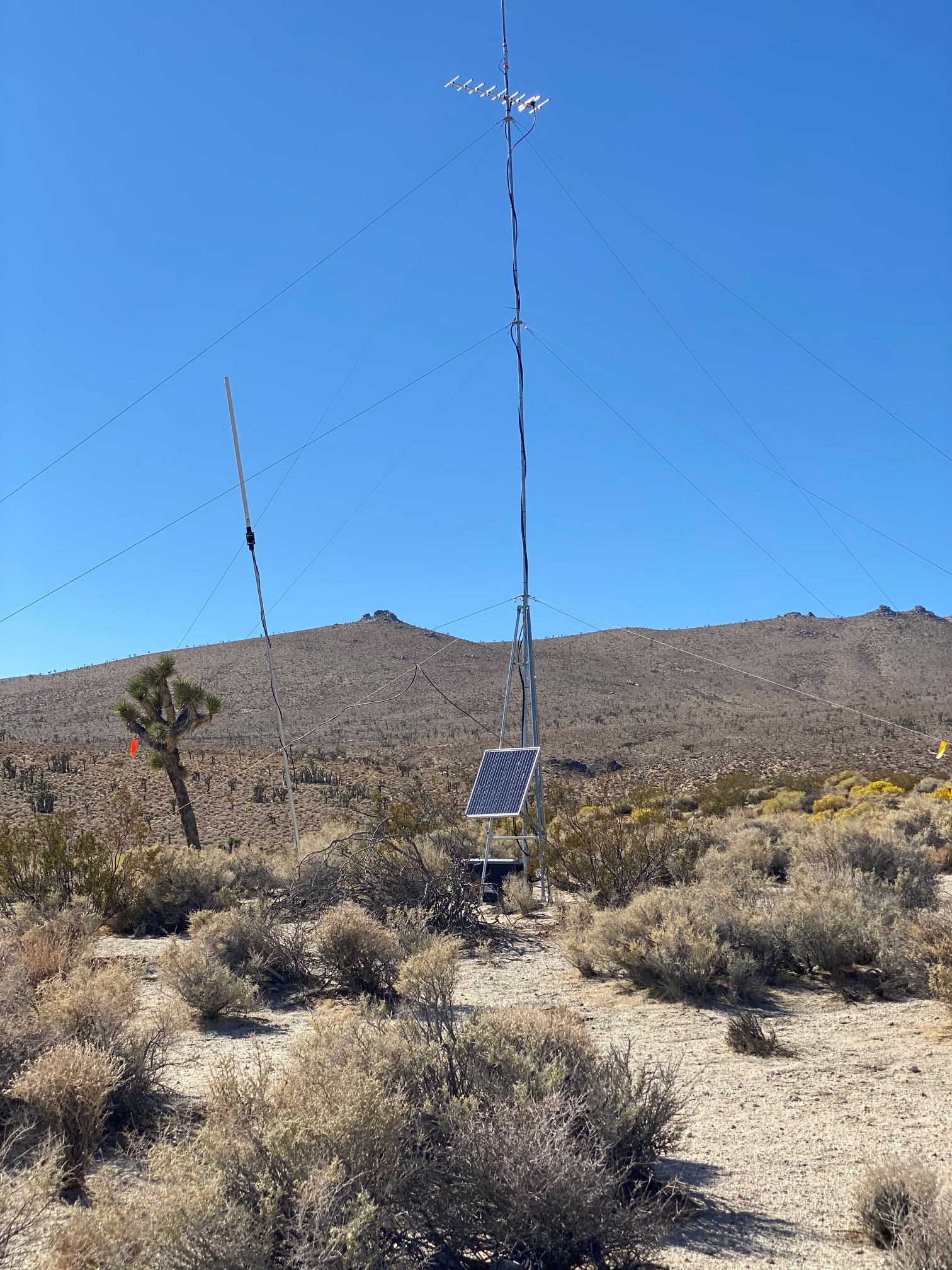
I am sorry I was not more specific with my question; I will provide much more information next time!!
I am enclosing PDF with our “How to Manual” so you can see what our “Mini Motus Station.”
Basically, I was thinking on top of it have another antenna for CTT tags.
What did you mean - “giving them a few inches at least” and then you write " Also, don’t mount them right next to the pole" - how do you mean that?
But if you look at the manual, basically to make this DUAL, we could just have 2 Antenna’s stands with both frequencies Omnidirectional antennas and have them maybe few feet apart? Would that work?
Eva, I think what you have in mind will work. Set up the 434 omni on a second mast at a convenient distance and run both to the same receiver. Pat’s photo does a good job showing this. Since you’re using a SensorStation, you’re only additional equipment will be the mast, antenna, coax and connectors. I’ve used this 5db omni from Data Alliance to good effect.
I couldn’t tell from your photos what size battery you are using, but we use 80 or 100AWG batteries on our 8-antenna stations and it does the trick. For only two omni’s something smaller would probably work, and be easier to transport.
I’ve been reading and asking around about antenna separation. The vast majority of information is either about separating transmit from receive antennas or about separation for antenna diversity, neither of which apply here. The consensus about receive-only antennas is that very little separation is needed. Anything beyond 4-6 inches apart is minimal and most likely quite difficult to measure if one wanted to. Obviously using multiple poles to separate antennas more doesn’t hurt, but you perhaps could have spent the money on buying better or more antenna/receiver gear…
The best info I have is that less than a half wavelength messes with the range of the antennas. Two yagis aimed opposite with 4-6” separation would look work more like a single Omni. We generally separate the most opposite antennas by no less than 1.5’ for 434 MHz and 6’ for 166 MHz
My understanding is that two yagies of the same frequency which are pointed 180 degrees apart should be spaced one wavelength apart; for a 166 Mhz frequency that means 1.8m, or about 6 ft. If they are pointed 90 degrees apart then a half-wavelength is adequate. The 166 Mhz antennas do not interfere with the 434 MHz antennas, regardless of spacing. And if you can get all the antennas for a given frequency in the same plane then there is no interference. The higher frequency (434 Mhz) antennas are smaller (due to smaller wavelength) and can easily be put in the same plane with a canopy fitting. One of the towers I worked on has four 5-element yagis at 166 Mhz and I was able to mount them back to back in pairs, with each pair spaced one meter apart… But the 9 element yagis are just too big to do that with.
As a Ham radio techie for almost 70 years (W3ASA) I fully agree with David. I was about to comment along the same lines. A few years ago I did some antenna characterization with a UHF tag on my drone. One instance, that you pointed out, where two Yagis at 180º appart with minimal spacing both had a bidirectional pattern. i.e. a single Yagi with half the elements configured for bidirectional performance would have been equivalent.
Please folks, to avoid confusion and the possibility of folks building stations based on anecdotal information, let’s refer to official guidance for antenna spacing from Motus. The document is here: https://docs.motus.org/en/stations/station-installation
CTRL+F “Antenna spacing” and there is detailed info and justification.
Hello All: Here's my 2 cents (and probably worth that much ;) )
Biggest issue: most of us are not radio engineers (although I know there are a few HAM folks in the group, as well as some more versed in antenna physics).
I spoke with the VP of M2Inc antennas a year ago and he basically said that the "separate by 1 wavelength" or the "1/2 wave cheat for 90 degree bearings" were based on very little empirical data, and akin to throwing darts at a dart board. He said that he had equipment that could actually test the effect of antennas on each other, and that they do it all the time. The question is really to what degree his precision relates to our application, so take it with a grain of salt. What we do know is that stacking antennas can have a very significant impact on the antenna's pickup pattern and is commonly used to extend the detection distance of an antenna array- so two antennas pointing in the same direction can be stacked to extend range. Therefore separating them as much as possible likely causes them to behave as depicted on their respective data sheets. I'm not going to pretend I know the ins and outs of this, some of our engineers have been collecting a lot of test data to try and empirically demonstrate this with regards to our tags and frequencies (mostly trying to minimize the effects of any interaction). I think a beneficial future direction of Motus could be to partner with a lab that specializes in antenna properties to really get a handle on how placement, stacking distance, and co-location of frequencies affects the true detection pattern at a given station. At the very least, testing various configurations with a drone could give the end user some useful knowledge, and could help refine the generic detection distances estimated on the Motus map (which, I think we can all agree, is misleading at best).
From what I have gleaned, the various frequencies used on Motus shouldn't interfere with each other, but antennas of the same frequency can definitely interact in ways that may not be clear to the user, and therefore really impact the probability of detection, something that already varies widely from station to station, and would be a great problem to solve so that we could have better estimates of detection probability across the network.
As for 434MHz Omnis, I've been using (and recommending) for years these inexpensive ones from Data Alliance. They're cheap, small, and have had simultaneous detections of far-off high-migrating birds with our yagi antennas (determined to be far-off via simultaneous detections at stations over 40 miles apart): https://www.data-alliance.net/antenna-433mhz-5dbi-omnidirectional-fiberglass-w-n-male-vhf-uhf-marine/
I use them for my Node network (to pick up the nodes) but they function great as presence/absence detectors at mini-setups too.
Cheers
David
David A. La Puma, PhD (He/Him) • Vice President, Global Market Development
celltracktech.com • (609) 889-0305 x104 • Book Time With Me
“If we did all of the things we are capable of, we would astound ourselves.” - Thomas Edison
You make a good point. It reminds me of a quote from somewhere: In
theory, theory and practice are the same. In practice, they are often
quite different.