We have been working to get our tower and sensor station setup over the last few years. I was not involved in the initial purchasing or installation so by the time it was passed to me by a retiring faculty I am trying to piece together what was done. I was able to get help from someone else in the MSP/Minnesota area to get enough details to get the station posted (Receiver #7153, CTT-C1EA5D622248) but I am left with burning questions. The tower was put up and then taken down when we had some construction on the building done. Unknown to us it was sending data to MOTUS each time it was setup without being registered with MOTUS. I just got it registered last month.
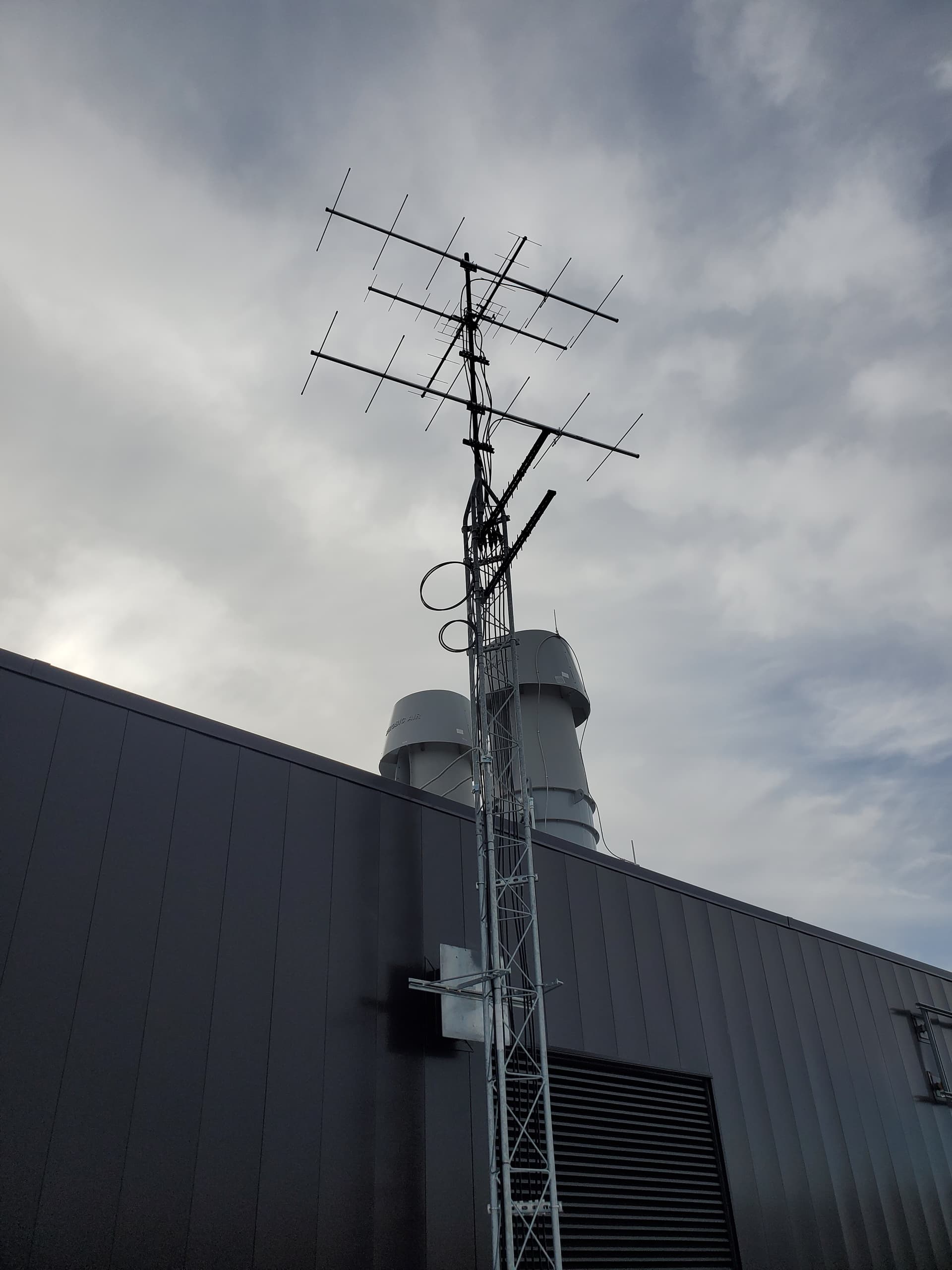
First burning question is why would there be two 6-element yagi’s both pointed East both for 166 MHz? Is this not a waste of an antenna? Just maybe an install issue? Seems most logical to have them pointed different directions (East/West). Top and bottom antennae in picture.
Second does a CTT station need a GPS fix if it is a permanent setup? The CTT was installed in a building which means it can not get a GPS fix (unless we add an external antenna). I understand if it is permanent the location will not move but is GPS needed for accurate timing of radio signals. I see there are no GPS fixes registered and I am surprised there are no tag detections considering it has been collecting data for well over a year.
Third question is just why our station does not show tag detections. Not a 0 or any other number. I saw that the “Status of Motus Processing” was crunching on our backlog of data for quite a while. Could it still be processing or is it a GPS issue? I was able to see some detections in R but some did not make sense based on the tag detected (false postives).
Looks like it has actually sent data recently (2025-02-24). You could have a look at the CTT portal to see what the raw data looks like, or download it from the Motus project page. Perhaps that can help you out.
On the topic of the two antennas… the station page confirms that they are both pointing in the same direction (bearing 89 degrees). The 2m vertical distance is probably only so they don’t interfere with each other. My best guess would be that they’re pointing into an expected migration route, and that there are two antennas for redundancy.
Stacking Yagi antennas vertically can be done by design to improve forward gain. You can calculate the vertical distance needed if you have the specs for the antennas to determine if it was done by design or for redundancy as Lynn mentioned.
Personally, I tend to point Yagis in different directions to get a broader coverage zone but there are certainly projects that would benefit from stacking.
Hi Scott, a few more details to add to what Lynn and Gavin provided…
Thankfully that’s easily resolved. Once the receiver is registered and a deployment created at a station, all previously uploaded data will be associated with the correct station. That would have happened here.
Good question! It may be, as Gavin suggested, that they are stacked, though it’s not obvious from the picture that they are connected. It’s also possible that it was in error and only realized once the installation was complete.
The GPS serves two primary functions: to save the station’s physical location (obviously), and as a time source. This SS appears to be connected to the internet, which can serve to set the time. And if the station is not mobile and the location metadata is correct, then acquiring the GPS location on the receiver won’t break anything. It’s certainly much more ideal for the receiver’s GPS to be functioning, though, and it’s worth troubleshooting that in person.
It could just be that no tagged animals have passed by; the number of detections is highly dependent on who is tagging what and where. A really good place to look is the deployment timeline. There are links to this on your Manage Stations page.
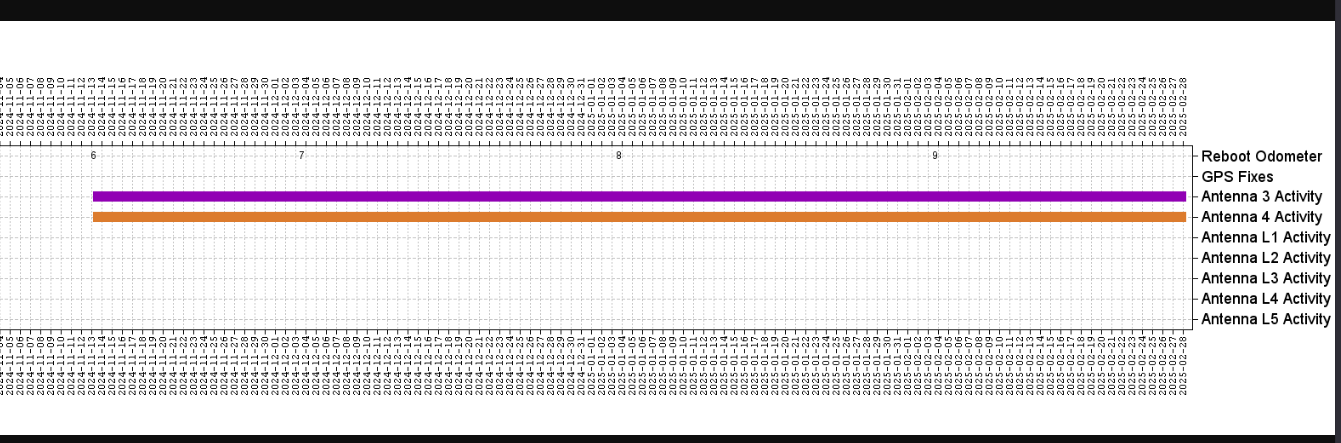
Looking at the screenshot below, you can see that there is consistent activity on both 166 MHz antennas since November 2024. Prior to that, it appears that the receiver was completely powered off or otherwise not functioning since April 2024. I would expect at least one detection in the time it was running and apparently recording fine, but it’s also possible to go that long without.
The 434 MHz antennas are a bit different. If you view the entire deployment timeline, you can see that there is activity between 2023-10 and 2024-04. But after the receiver started recording again in 2024-11 nothing at all was recorded on those antennas. This is a red flag considering the prior history. In fact, even without antennas attached, the integrated 434 MHz radios often record some hits from ambient radio noise. It’s worth a visit with a laptop and Ethernet cable to connect to the SS to see if there are any issues. For instance, it’s possible that the 434 MHz radios were accidentally set to “node” mode.
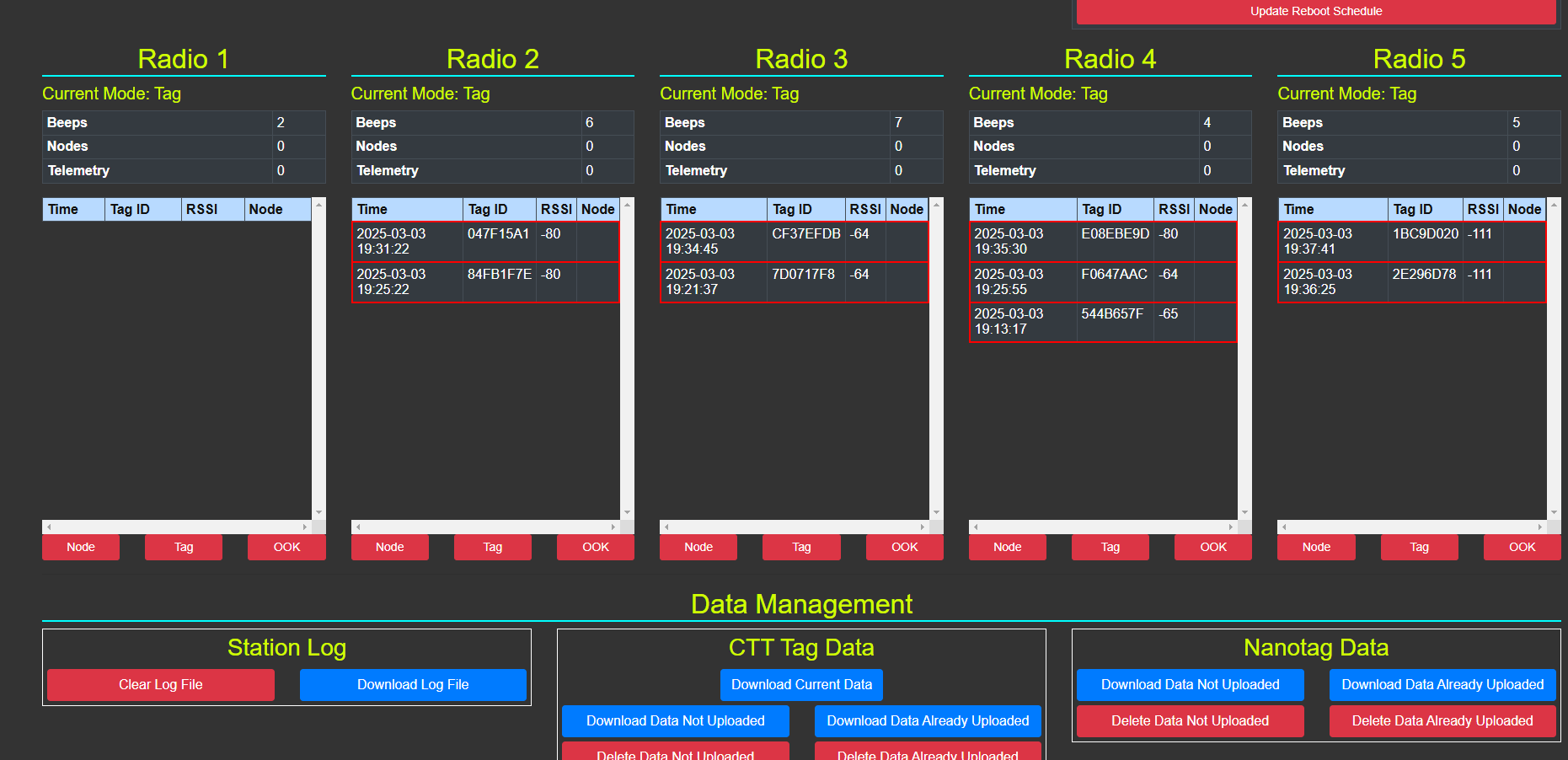
Appreciate the help. I have easy access to the CTT Sensor Station page through a browser anywhere on campus. I don’t see any obvious issues besides the lack of GPS fixes. All radios appear to be set as tags. All seem to be recoding activity.
I don’t think the antennae were stacked to increase gain as they are not combined (they go to separate channels/radios on the CTT). As far as I can tell to increase gain they must be linked by a combiner before entering the CTT. So the only other explanations were a mistake or redundancy. Nice to know that the data gathered when they are like that is not a complete waste (redundant). Sounds like I will be requesting them to turn one of the antennae and add a external GPS antenna so we can get GPS fixes. I still wonder why there is not a tags detected on our station? When I look at other’s stations on the map they have a “tags detected” most of the time even if it is 0. Be nice to see some tags just to know it is working.
Additional thought:
If your Motus station has not detected a tag yet, in my experience it will not say “Tags Detected: 0” but instead, will not yet have that description line in the station summary, until you actually get a tag detection.
Looking at the picture, your station is awesome-ly built and I would also think you should switch one of your 6-element 166MHz antennas to another direction (if you do so, don’t forget to end the station deployment and create a new one with correct antenna info).
There’s potentially some radio interference going on, which could reduce your capacity to detect tags. If you suspected there might be noise due to any large electical or electromagnetic interference nearby (or comms), there’s several ways you could look at the data that’s already been recorded by your station to see what the environmental noise levels might be, or you could purchase or make a radio noise tester. In any case, I would recommed you try and obtain a CTT tag and a Lotek tag and bring them to your station to see if they are detected. I highly recommend you test with tags in hand, whether your station is detecting tags or not. You could also conduct tag range detection tests, where you walk/drive, or fly further away from your station to see how far your Motus station can detect your tags.