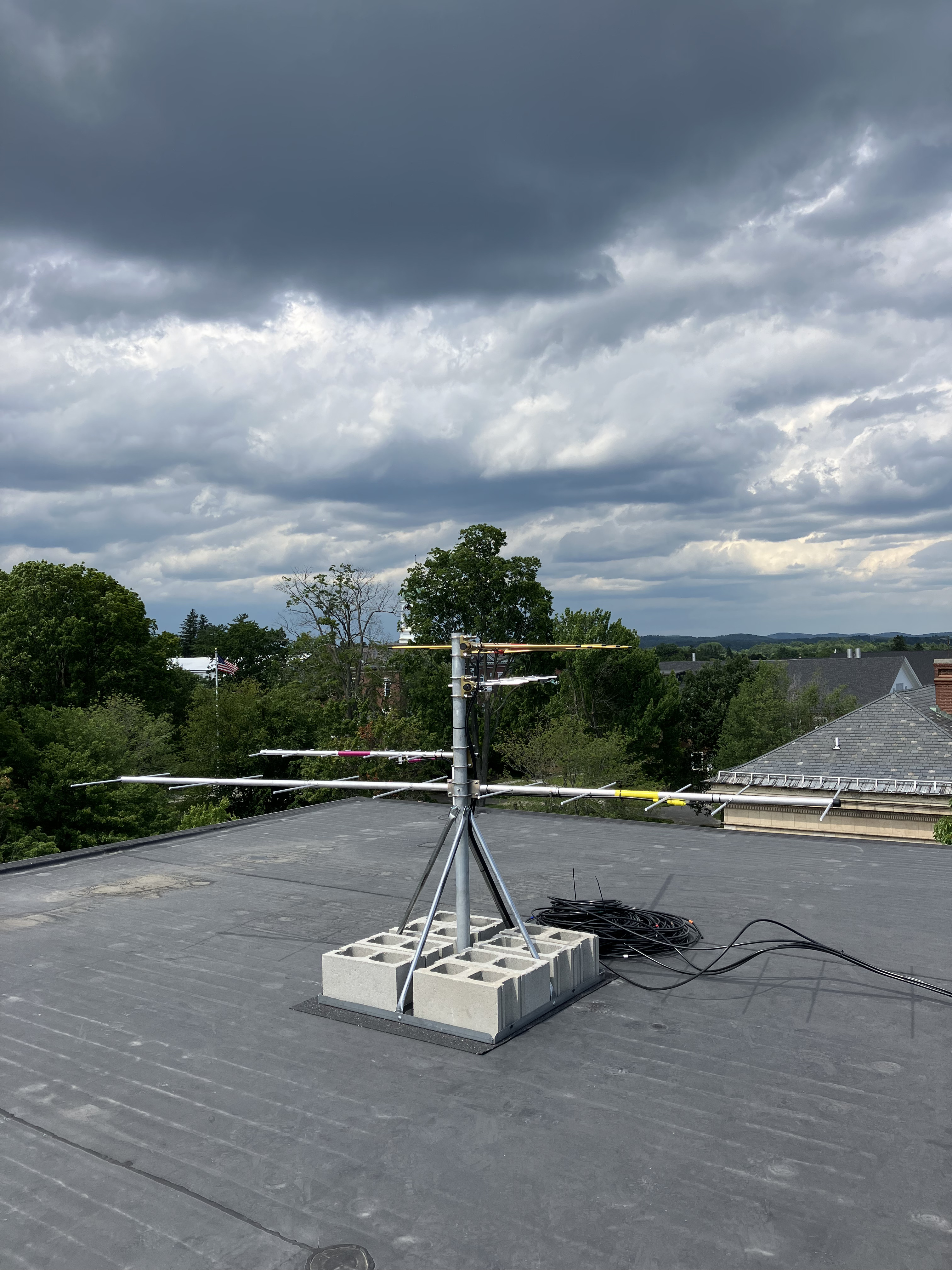
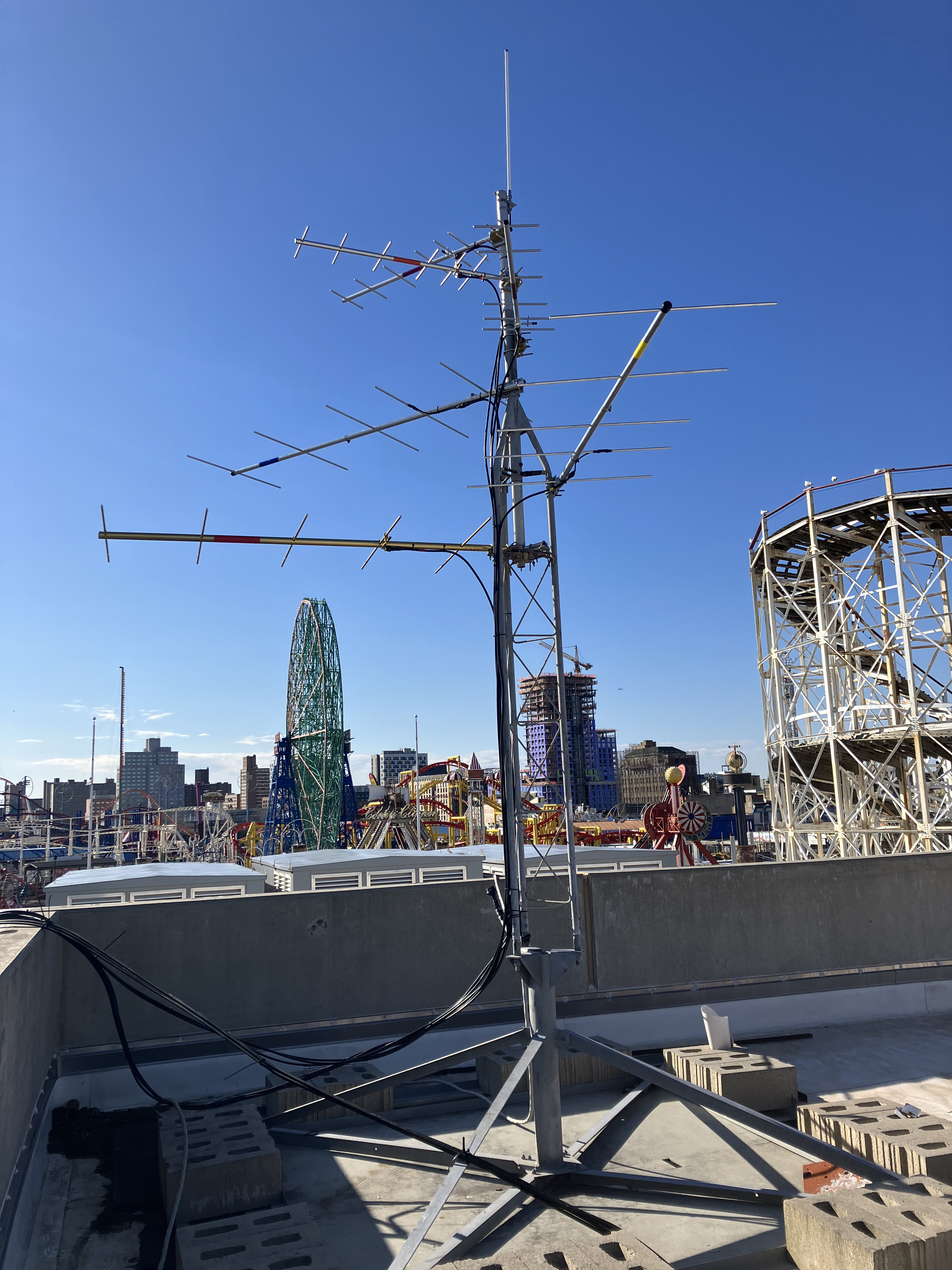
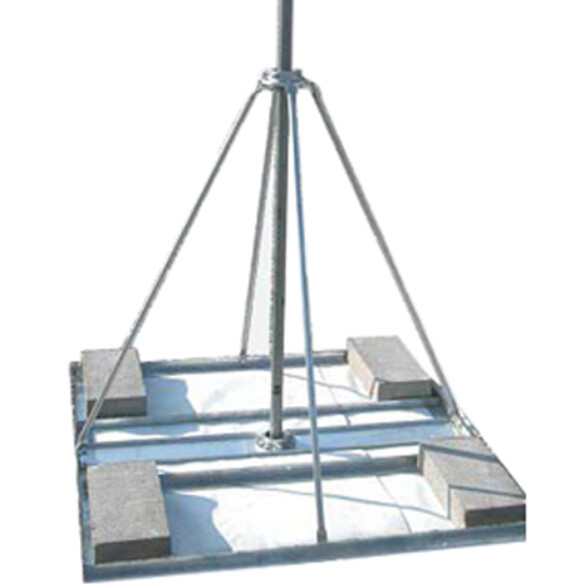
I thought it may be helpful to share my experience with calculating ballast requirements for non-penetrating roof mounts. Also interested in hearing about other people’s experience.
Essentially, given different wind environments and antenna configurations, I want to know how much weight I need to put on the platform to secure the mount to the building.
A simple equation
The manufacturer in Canada doesn’t have datasheets so I’ve used the Rohn FRM mounts to make a safe guess since they are a very similar design but a bit smaller and lower gauge.
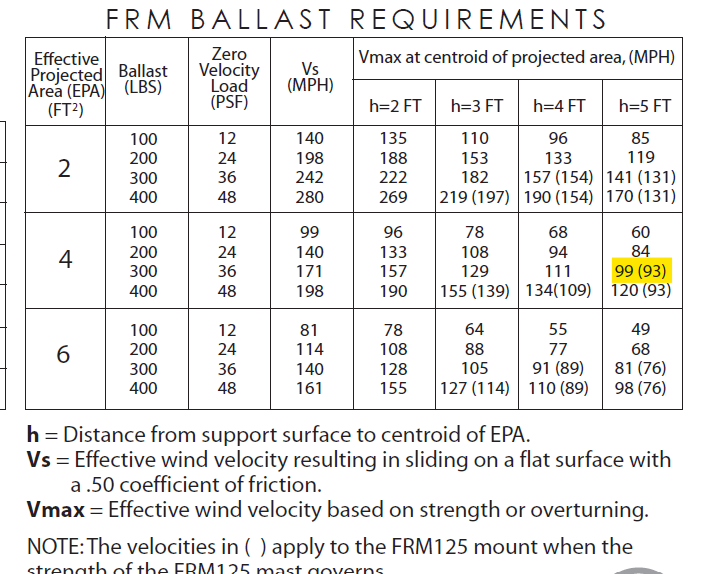
The datasheet: ROHFYS200.pdf (2.6 MB)
There’s a bit of math, but really it’s just plugging in numbers to a simple equation:
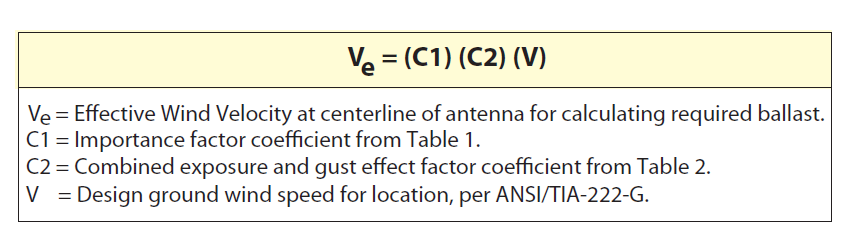
The confusing part is figuring out which numbers to plug in, but they have a helpful example that I followed.
Here’s what I did:
Finding the values
Based on the fact we’re going to need to withstand a potential hurricane (about 90mph), and we’d be placing this on a community college (risk class II) at no more than 40 feet about the ground in a forested area, I get the following values:
C1 = 1.38, C2 = 0.82, V = 90 MPH
Which, if I plug into the equation above, gives me:
Ve = 1.38 * 0.82 * 90 = 102 MPH
Estimate centroid and EPA
Now to calculate the ballast, I just need to know the centroid as well as the effective projected wind area of the antennas.
- The centroid is a bit of a guess, but it’s essentially the midpoint of the mass on the antenna which I imagine it will probably be close to 5 feet for most Motus stations so I’ll go with that.
- As for the effective projected wind area (EPA), it depends on the number and type of antennas. This is usually provided in the antenna spec sheets, but keep in mind that for Yagi antennas the amount listed is the maximum amount which would be if the elements were facing vertically which we don’t do - we face the elements horizontally. So this reduces the effective wind area significantly. This is a breakdown of my rough estimates for EPA for antenna models:
| Frequency | Antenna model | Effective wind area (EPA) |
|---|---|---|
| 166 | Yagi 9 element | 0.75 sq. ft. |
| 166 | Yagi 5 element | 0.5 sq. ft. |
| 166 | Omni | 0.75 sq. ft. |
| 434 | Yagi 6 element | 0.5 sq. ft. |
| 434 | Omni | 0.6 sq. ft. |
*Keep in mind this doesn’t account for ice buildup, if your winter storms are like hurricanes this should be considered.
So in my case, I was going to install 2x 9-element Yagis on 166 MHz and 2x 6-element Yagis on 434 MHz, giving me about 2.5 sq ft of effective wind area.
Find the weight
Now using the table in the datasheet, I could find that I’d probably be safe with about 300 lbs of ballast given Vmax at the centroid is about 102 MPH and 300 lbs of ballast should be good for 99 MPH which is close enough for me.