I tagged a bunch of Gambel’s White-crowned Sparrows this past March-April in Southern California and have gotten several pings on our birds, all in expected areas. However, some data just came through on one bird that has now been detected at a tower all the way in Eastern Canada (on Prince Edward Island). Do we think that this is accurate? Or could this likely be tag aliasing?
The bird was originally tagged on March 23 in range of the Cinega Springs tower in Southern California. It continuously pinged this tower until April 10, where it presumably left for spring migration. It was picked up at a subsequent northbound tower on April 25. There have been no other pings for this bird until August 4, where it was detected at the Cabot Beach Provincial Park tower in Eastern Canada.
If this is due to tag aliasing, can someone explain to me what would cause this on a tag that was successfully picked up at the tower it was tagged at and an additional northbound tower during its migration?
I don’t know if this will be helpful or not, but here is Grok’s analysis of the unusual pings:
Tag aliasing is a known source of false detections in the Motus Wildlife Tracking System (especially with Lotek nanotags).
How it works Lotek tags encode a unique Motus Tag ID using two main elements:
The Lotek Tag ID (the precise spacing of the four pulses in a single burst).
The burst interval (the time between successive bursts).
When multiple real tags transmit near the same receiver at the same time, their pulses can overlap. The receiver’s tag-finder algorithm can then interpret the mixed pulses as belonging to a different tag ID that is not actually present. This creates an “aliased” (false) detection.
There are three main types:
False burst interval (rarer) — often involving tags with the same Lotek ID.
False Lotek Tag ID (most common) — typically when many tags with the same burst interval are near each other.
False burst interval + Lotek Tag ID (rarer, requires more precise overlap).
Aliasing is most likely when many tags are deployed together and stay in close proximity afterward (e.g., colonies, roosts, or large tagging events). It is much less of an issue with CTT tags because of their different coding system.
Relation to the email scenario In the email, the Gambel’s White-crowned Sparrow was correctly detected at the Southern California tagging tower and a later northbound tower. Those detections confirm the tag itself was working and its ID was real.
The later detection at Cabot Beach Provincial Park on Prince Edward Island is far outside the normal range for Gambel’s White-crowned Sparrows (which are primarily western, breeding in Alaska and northwestern Canada and wintering in the southwestern U.S./Mexico). That makes the PEI hit biologically implausible and a strong candidate for a false detection caused by tag aliasing.
Most likely, other real tags near the PEI tower (with overlapping signals) produced a pulse pattern that matched this bird’s Motus Tag ID, generating an erroneous detection. This can happen even if the original tag was successfully read earlier—aliasing is a local phenomenon at the receiver where the overlapping signals occur.
Practical notes
Motus documentation and community discussions treat aliasing as a recognized data-cleaning issue. Researchers are advised to look for biologically implausible detections, especially isolated ones far from expected routes, and to check whether other tags with the same burst interval were active nearby.
Mitigation tips include staggering deployments (in space or time), using a mix of burst intervals, and avoiding large numbers of same-interval tags at one site.
In short: the PEI detection is very likely an aliased false positive rather than a real long-distance movement of that individual.
Hi folks, this page gives a good overview of the main types of false detections. It also also includes links to relevant chapters in the R package documentation for how to deal with them in the R package.
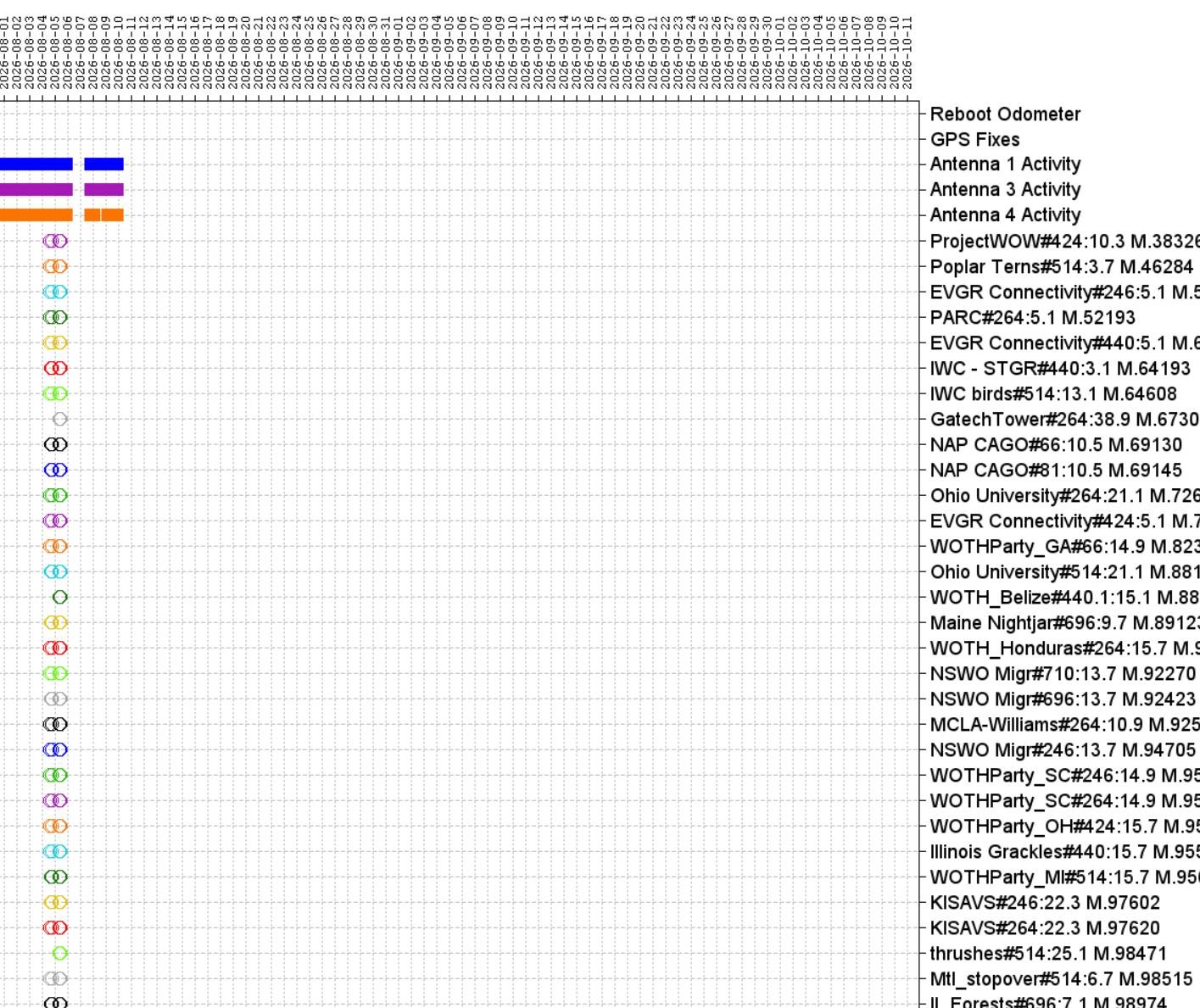
In this case, this would be the result of a noise event. You can see in the screenshot below a variety of tag “detections” all within the same discreet period and having a number of different burst intervals. False detections as a result of aliasing usually have the same burst interval as the tags present.