my project at the German North Sea coast is interested in offshore movements of birds. So we got the idea to install receivers on buoys as an addition to our coastal network which at the moment features only very few receivers on stable (ground fixed) offshore platforms. We are very hesitant to use Yagi Antennas on the larger buoys (~10m above water), and on the smaller ones (~2m above water) it is impossible anyways. All of the buoys we are interested in provide a compass direction, some even data on the inclination of the buoy, so it would be possible to calculate a Yagi-antennas direction. However, we believe that water hammering and the constant /often rapid movements of a buoy on its anchor chain is a big issue. I am curious to hear whether anyone of you is operating antennas on moving structures? Does anyone use smaller and more robust (possibly omnidirection (with amplifier?) antennas?
Cheers,
Vera
I’ve been following this thread with interest; my group is just getting started on an effort to track small aquatic shorebirds (phalaropes), both at on-shore lake sites and offshore, for the two species that winter at sea. I’m wondering about Jim’s answer – what are the implications of using omnidirectional antennas on buoys for detection distances?
Bruno-
I agree the LNA does provide gain and the need for a bandpass filter. I have found that at VHF frequencies (150 MHz, 166 MHz) the signal to noise ratio (SNR) is not improved with a LNA since the noise is determined by atmospheric noise rather than thermal noise of the first stage of the receiver. At UHF (434 MHz) the atmospheric noise is less and a LNA can improve the SNR and hence detection range. However, the caveats about IM from adjacent strong signals still apply.
The LNA I used for my testing was $11 from Amazon. See page 7 of my report attached.
Corrosion by salt is of course a huge problem of course; epoxy does maybe the trick? If you will go for this plan, I would suggest to use a big Lithium battery and a pi zero with one antenna. Hopefully you can find a setup that will last long enough during an Autumn migration season. Don’t waste energy of the battery on mobile data; you can easily update the data later on I assume.
Very interesting, I am very curious what the outcomes of your plans are. Finding and get permission for locations is a hell of a job; for offshore locations I can imagine even worse…
Hi Jim,
Thank you very much for sharing your report.
I noticed in your report that you got poor detection range at the first time.
We got poor result too and were wondering if the fans of the drone would interfere the radio signal,
so we hanged the tag with a 2-m thread beneath the drone and we did get better signal.
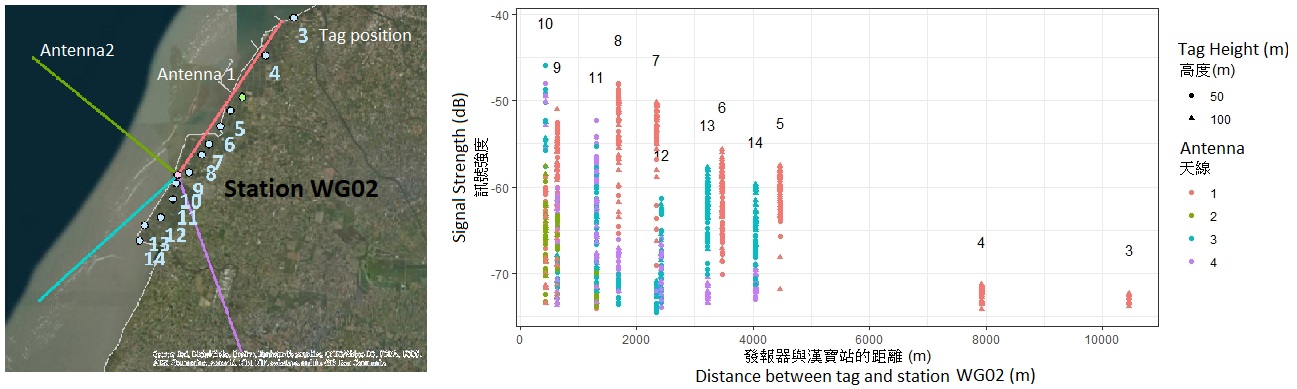
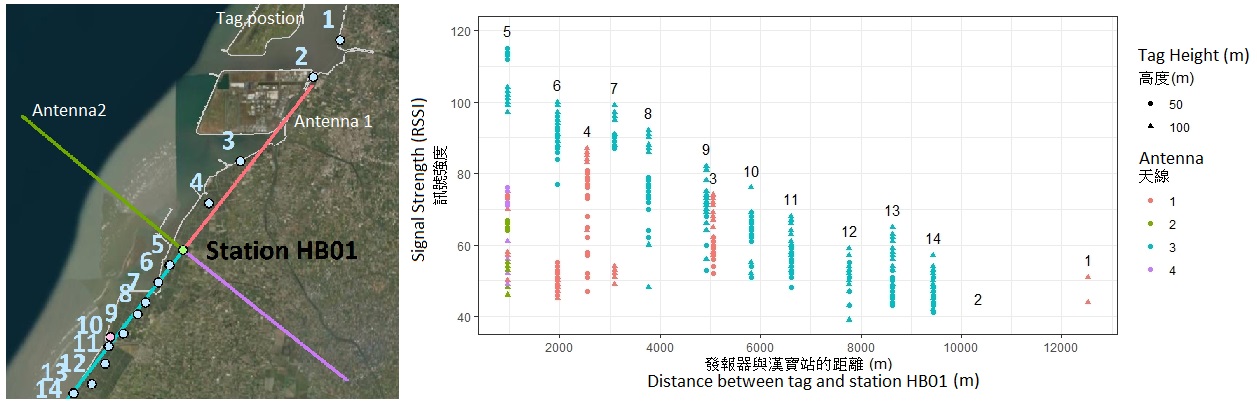
The station with 4 8-element yagi antennae could pick up the NanoTag when the tag was >10 km away at the height of 100 m,
although the signal was intermittent.
I attach the tag testing results with our two stations at the west coast of Taiwan.
Instead of moving on a certain route, we test the tag at 14 places, mostly on the direction of the antennas.
I am unfamiliar with radio.
To your knowledge, do you think the fans could possibly cause the radio interference?
Would the fans of the windmills possibly cause the radio interference too?
Another thing is that the detected radio signal strength of your CTT towers ranges from -110 to -70 dB,
but our SG tower ranges from -75 to -45 dB.
Does that mean the signal strength wouldn’t be a good reference among different types of receivers?
Cheers,
Emilia
Jim Moore 在 2020年9月30日 星期三上午12:32:15 [UTC+8] 的信中寫道:
Obviously there are many challenges to offshore tracking but you’ve identified some of the major ones. We’re working with several clients to install SensorStation on buoys in the western Atlantic. For some we’ve recommended omni antennas which are very low profile, and have demonstrated excellent range in field testing (we’ve picked up Tree Swallows wearing LifeTags at > 20-30km on both the omni and smaller 6-element Yagi antennas). Clearly they’re better for presence/absence, but the tradeoff is no horizontal antenna banging around on a buoy, often loaded with other primary equipment anyway. That said, there are some very short yagis which can be a good compromise to get directionality without major infrastructure (primarily for 434MHz as the wavelength is 70cm vs the 1.8m of 166MHz). In some cases the SensorStation is running off the same power source on the buoy, which is self-generated via solar and wind. We have added Iridium modems to these units so that they can send data remotely during deployment. Of course, as Rene said, you can save on data costs and power by recovering the data after deployment, but the remote data does give you peace of mind that the system is continuing to operate as expected during deployment. I know Pam Loring has been working on some of these projects and may have some insight into the development of new antennae for offshore deployments.
Thanks for sharing your data on signal strength vs. distance for the NanoTag. You got much better range (10 km) than we did in our tests which was less than 1 km!
I copied David Brinker on this email since he did some testing at Assateague, NJ last year and as I recall got similar results that I did.
To answer your questions:
The fans of the drone would not have any effect on the signal since they are plastic and non-conductive. Antenna orientation and the effective ground plane, however will affect the signal strength possibly as much as 10 to 20 dB.
The reported signal strength (RSSI) is only relative and you are correct in that it would not be a good reference when comparing receivers. The only important parameter is what is the maximum range where the signal is still detectable before it is lost in the background noise. Higher gain antennas will improve the detectable range but only at the bearing of the main antenna lobe.
I don’t know why the big difference in field tests - <1 km vs. >10 km. I did test another NanoTag as discussed on page 4 of my report which had 12 dB higher ERP than the tag I had been testing. I understand that the power output can be programed on the chip. Perhaps Lotek has some tags programmed for higher power output which would improve range at the expense of battery life.
We did try different ways to stick the tag on the drone so that the antenna could point to different directions.
However, none could get a good signal compared to the hanging one. hmm…
Many thanks for the shout-out and all of the great info. The system that we are currently looking toward for buoys consists of:
Receiver: CTT SensorStation that has an Iridium modem/data plan for remote download of summary-level data and system health reports: link here
remote monitoring of offshore stations is highly recommended to ensure data quality and consistency due to infrequent, in-person service trips and the harsh marine environment increasing risk of power loss
Antenna: a single omnidirectional antenna to receive signals of 434 MHz tags: link here
for buoys, especially that are relatively short, our technical team had concerns about wave action causing lots of reflection/variability of signals received by Yagis, and recommended instead using a single omni. Use of a single omni may also be preferred from a logistics standpoint if space on the buoy is limited. However, it is important that the omni is mounted in a configuration to reduce interference from other equipment/metal on the buoy, which is an ongoing discussion that I would happy to be part of as folks continue to test equipment configurations offshore
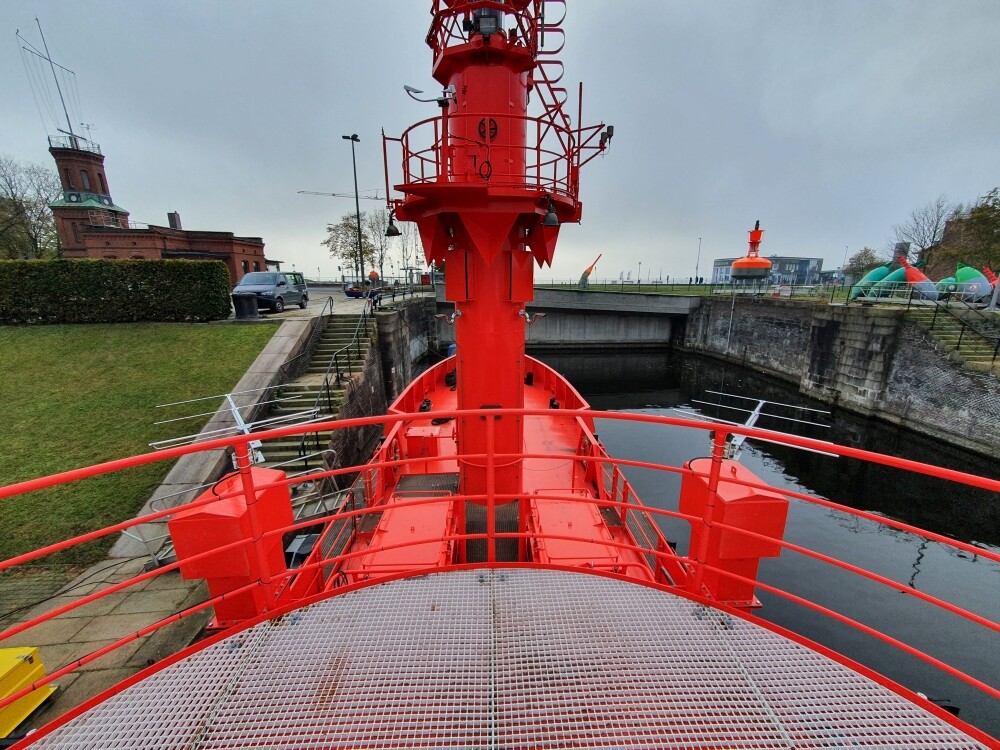
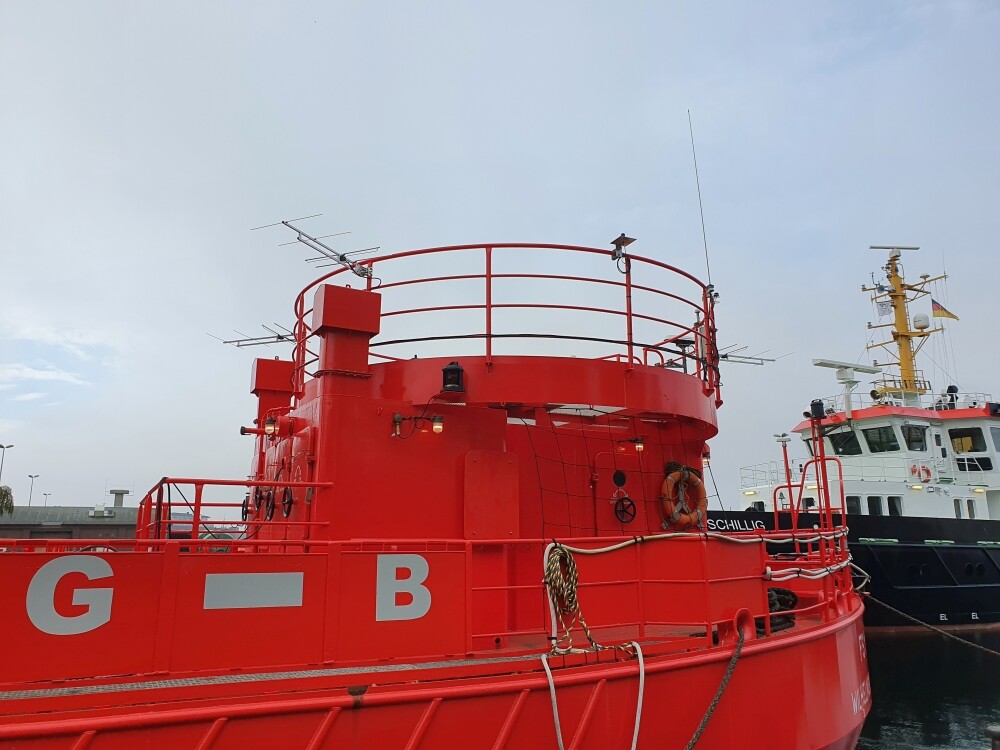
actually we ended up not putting antennas on buoys. Instead, we now have a setup on a fire vessel and hope to add another one of those to our receiver network soon. These ships are anchoring at a permament offshore position. We used shortened 4 Element Yagi Antennas as shown on the pictures attached. The ship is out there just a few days so no results to report so far.
I looks like a hell to get permits to install towers offshore. In Flanders after two years we fixed it last year on a trafo station. That gives plenty noise, but well… it gave already also two detections of two different wheatears (Oenanthe oenanthe).
How is the bouys idea playing out? It sounds great, but is it possible? Ferries has also (plenty) noise, but maybe an idea? Wind turbine promotors are complaining… Have others maybe great ideas? Very curious to hear your thoughts!!
Are there already new brain waves for more offshore stations?